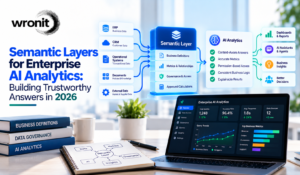
A semantic layer for enterprise AI analytics helps AI assistants interpret business questions using consistent metrics, defined relationships, and approved business terminology. It improves the foundation for trustworthy answers, but organizations must still verify calculations, enforce data permissions, and test the system against independently checked results.
This has become increasingly relevant for US enterprises. On September 17, 2026, USEReady announced SemaBridge for Snowflake, emphasizing governed semantic definitions for production AI agents. Snowflake subsequently made Semantic Studio generally available on September 30, 2026. These developments reflect growing attention to a practical enterprise requirement: AI-generated analysis must preserve the meaning of business data.
For organizations investing in conversational analytics and AI agents, the challenge is determining whether an answer is correct enough to support a business decision.
What Is a Semantic Layer in Enterprise AI Analytics?
A semantic layer is a business-oriented representation of data that defines metrics, entities, relationships, and analytical rules independently of how information is physically stored.
It allows business users to ask questions using familiar terminology without needing to understand every database table or SQL join.
 For example, consider a finance director asking:
“What was our net revenue last quarter?”
A reliable analytical system needs to establish whether net revenue excludes refunds, discounts, taxes or particular transaction categories. It must also apply the correct reporting period, currency treatment and access permissions.
Without approved definitions, an AI assistant might select a plausible revenue column and produce a mathematically correct calculation that conflicts with the organization’s official financial reporting.
A semantic layer helps establish the intended calculation before the assistant queries the underlying data.
Semantic layer vs. data catalog vs. RAG
These technologies support different requirements.
Technology
|
Primary responsibility
|
Important limitation
|
| Data catalog |
Discover data assets and document business context |
Does not ensure calculations use the correct logic |
| Semantic layer |
Define business metrics, entities, and relationships |
Cannot independently guarantee source-data accuracy |
| Retrieval-augmented generation (RAG) |
Retrieve relevant documents and supporting context |
Retrieved passages may not represent complete transaction populations |
| Analytics agent |
Interpret requests, execute tools, and explain findings |
Does not automatically establish authorization or correctness |
An enterprise architecture may combine all four.
For numerical business questions, the preferred approach is generally to calculate results through an approved metric service or governed analytical query, using document retrieval for supporting explanations.
Why Can AI Analytics Produce Incorrect Answers From Correct Data?
AI analytics can return incorrect business results when it misunderstands the calculation, reporting grain, relationships, or filters, even when the underlying data is accurate.
Consider a hypothetical customer support operation.
The organization has 1,000 eligible closed support tickets. Of these, 400 were resolved without human intervention and remained closed throughout the required seven-day observation period.
The approved automation resolution rate is:
\[ \frac{400}{1000}\times100=40\% \]
Now suppose an AI-generated query joins the ticket table with the customer message table before calculating the rate.
Each automated ticket contains four messages, while each human-assisted ticket contains ten.
The resulting calculation becomes:
\[ \frac{1600}{1600+6000}\times100\approx21.1\% \]
Both queries execute successfully, yet the second measures the proportion of message records associated with automated tickets rather than the proportion of tickets resolved automatically.
The problem is known as join fan-out, where a relationship multiplies records and changes the effective reporting grain.
A trustworthy semantic model must therefore define what each record represents, which joins are permitted, and how metrics should be aggregated.
Tools such as dbt MetricFlow document relationship-aware join handling to reduce these risks.
The example is illustrative and does not represent a Wronit customer implementation.
What Makes an Enterprise Semantic Layer Reliable?
A production-ready semantic layer requires more than a glossary of business terms. It needs governed definitions that can be consistently interpreted, executed, tested, and maintained.
1. Approved business metrics
Each critical metric should have a documented owner and calculation.
For example, an automation resolution metric should specify its numerator, denominator, exclusions, observation window, and treatment of reopened tickets.
Where possible, the approved definition should be executable rather than existing only as descriptive text.
2. Correct data relationships
Relationships between customers, orders, transactions, and messages must preserve the intended analytical grain.
Incorrect joins can distort revenue, retention, customer counts, and operational performance measures.
3. Data quality and freshness
AI-generated answers are only as dependable as the available source data.
Organizations need checks for missing records, duplicates, delayed updates, inconsistent identifiers, and incomplete reporting periods.
An assistant should also disclose when the latest data is unavailable.
4. Governance and access control
Access restrictions must be enforced by authenticated application and data-platform controls.
A prompt instructing an AI assistant to respect permissions is insufficient.
5. Versioning and change management
Business definitions evolve.
Finance may revise revenue treatment, operations may change service-level calculations, and data teams may restructure source tables.
Semantic definitions should therefore support ownership, review, version control, regression testing, and rollback.
Snowflake’s semantic views documentation describes business metrics, entities, and relationships as part of its semantic modeling capabilities.
How Should Enterprises Secure AI-Generated Analytics?
Security should be enforced throughout the analytical execution path, including query execution, retrieval, caching, and output delivery.
Consider an enterprise operating across the United States and UAE.
A regional sales manager may be permitted to view UAE performance but not confidential US customer records. A global executive may have broader access, while an external contractor may have access only to aggregated information.
The AI assistant must respect those differences even when users ask equivalent questions.
A practical security design includes authenticated identity propagation, row-level filtering, column masking, least-privilege tool permissions, and audit logs.
Databricks documents how Genie Agents can evaluate access using end-user Unity Catalog permissions, including applicable row filters and column masks.
However, security testing must also cover indirect requests, conversation history, cached answers, and exported reports.
The critical test: Can a user retrieve information through the AI assistant that the same user cannot access through the governed data platform?
If so, the implementation requires correction before broader deployment.
For organizations planning these controls, Wronit’s AI governance and compliance services provide a relevant starting point for discussing access, oversight, and AI risk requirements.
How Do You Evaluate Whether an AI Analytics Answer Is Trustworthy?
Enterprises should evaluate AI-generated analytics against independently verified reference answers rather than relying solely on fluent explanations or model-generated quality scores.
A useful evaluation framework covers six dimensions.
Evaluation area
|
Example test
|
Expected result
|
| Business meaning |
Ask for automation resolution using different wording |
Consistent approved definition |
| Calculation accuracy |
Compare totals and ratios with validated SQL |
Reconciled results |
| Data relationships |
Join tickets with multiple messages |
No unintended duplicate counting |
| Time handling |
Query incomplete reporting periods |
Correct caveat or exclusion |
| Permissions |
Request restricted regional data |
Access denied or appropriately limited |
| Explanation quality |
Ask why a metric changed |
Evidence-backed interpretation without unsupported causation |
These tests should include ambiguous questions, follow-up conversations, and changes in user permissions.
For higher-risk business metrics, a human reviewer should examine significant failures and a representative sample of successful answers.
What should the business user see?
A trustworthy answer should make five details available:
-
Metric definition and reporting period
-
Applied filters and user scope
-
Data freshness or last update
-
Supporting calculation or query reference
-
Limitations and unresolved ambiguity
For example, an AI assistant reporting a 40% automation resolution rate should explain that 400 of 1,000 eligible tickets met the approved criteria.
It should not automatically interpret that figure as 40% labor savings or improved customer satisfaction.
Those conclusions require separate evidence.
Should Enterprises Use Native AI Analytics or Build Custom Agents?
The choice depends on existing data infrastructure, security requirements, workflow complexity, and the ability to validate answers.
Decision factor
|
|
Custom analytics agent
|
| Existing data environment |
Often suitable for a consolidated platform |
Useful across multiple systems |
| Business metrics |
Can reuse supported platform definitions |
May require custom metric integration |
| Security |
Can leverage native platform controls |
Requires end-to-end authorization design |
| User experience |
Platform-defined capabilities |
Greater interface flexibility |
| Maintenance |
More vendor-managed functionality |
More engineering ownership |
| Best fit |
Governed self-service analytics |
Specialized cross-system workflows |
For businesses already using Snowflake, Databricks or a mature BI environment, evaluating native capabilities first can reduce unnecessary integration work.
A custom agent becomes more relevant when users need to coordinate several systems, follow specialized workflows or combine analytical results with other approved business operations.
Neither approach removes the need for evaluation.
A Practical Roadmap for Enterprise AI Analytics Adoption
The most manageable starting point is one business domain with established reporting and an accountable metric owner.
Enterprise implementation framework
-
Select a measurable use case. Choose recurring questions that currently require analyst support.
-
Validate the data foundation. Reconcile source records, reporting tables, and critical metrics.
-
Establish semantic definitions. Document calculation rules, entities, relationships, and ownership.
-
Enforce access controls. Test different user roles and restricted data scenarios.
-
Build evaluation datasets. Prepare reference answers, edge cases, and permission tests.
-
Pilot and measure outcomes. Track accepted answers, material errors, review effort, latency, and total cost.
Organizations should measure the cost of an accepted answer, not simply the cost of an AI response.
A low-cost answer that requires extensive analyst correction may be less economical than a more expensive but reliable query.
Wronit’s data engineering services, data warehousing solutions and data analytics consulting align with the foundational data preparation and reporting requirements of such an initiative.
For US and UAE deployments, teams should additionally review regional access policies, reporting time zones, data-location requirements, and applicable privacy obligations. Cross-border availability or regulatory compliance should not be assumed from a platform’s marketing description.
FAQs
Does a semantic layer eliminate AI hallucinations?
No. A semantic layer improves business context and can standardize metrics, but incorrect source data, ambiguous requests, generated queries, and unsupported explanations can still produce errors. Independent evaluation remains necessary.
Can an enterprise use a semantic layer with RAG?
Yes. RAG can retrieve relevant policies, definitions, and explanatory documents, while a semantic layer supports structured business calculations. The two can complement each other within a governed analytics architecture.
What is the difference between a semantic layer and a knowledge graph?
A semantic layer primarily organizes business concepts, metrics, and analytical relationships. A knowledge graph represents entities and their connections more broadly. Some enterprise systems combine both approaches.
How do you measure AI analytics accuracy?
Compare AI-generated results against independently verified calculations. Evaluate numerical correctness, business meaning, permitted access, time handling, and explanation quality. Track material failures separately from minor presentation issues.
Is a semantic layer necessary for every AI application?
No. Applications focused on document summarization or classification may not need one. It becomes particularly valuable when AI must interpret enterprise metrics, generate analytical queries, or provide consistent business answers across reporting systems.
How should a company begin implementing trustworthy AI analytics?
Start with one reporting domain, approved metrics, reconciled data, and a controlled group of users. Build reference tests before expanding access, and require business-owner acceptance before production rollout.
Build AI Analytics on Business Definitions You Can Trust
Reliable enterprise AI analytics requires a coordinated foundation of data engineering, governed metrics, secure access, and measurable evaluation.
Wronit supports organizations developing the data infrastructure and analytical systems required for enterprise AI initiatives.
If your organization is evaluating semantic layers, conversational analytics, or AI-powered business reporting, contact Wronit to discuss a focused assessment of your data architecture, metric definitions, and implementation requirements.
#Semantic Layer for Enterprise AI Analytics#semantic layers improve enterprise AI