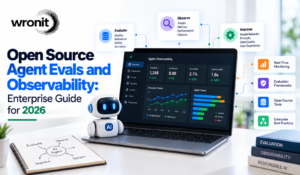
Open source agent evaluation and observability tools help enterprises test AI agent behavior, trace decisions and tool calls, detect failures, and verify whether automated workflows actually achieve their intended business outcomes. The distinction is becoming increasingly important. On October 13, 2026, Reuters reported that US banking regulators were examining how financial institutions monitor, control, and audit autonomous AI systems.
For enterprises deploying AI agents across customer support, finance, operations, or internal systems, the implication is clear: a convincing answer is not proof that the workflow succeeded.
An agent might confidently confirm that a support ticket was created even though the underlying API rejected the request. Without execution traces and independent outcome verification, that failure could remain invisible.
The practical challenge is connecting three things: what the agent attempted, what the evaluation measured, and what actually happened in the business system.
What Are AI Agent Evaluations and Observability?
AI agent evaluation measures whether an agent behaves correctly against defined criteria. Observability records the evidence needed to understand how the agent executed a task.
Although closely related, they answer different questions.
An evaluation might determine whether an agent selected the correct customer record, respected a policy, or completed a requested action.
Observability helps engineers investigate the execution behind that result, including model requests, retrieved documents, tool calls, errors, latency, and downstream operations.
According to OpenTelemetry’s tracing documentation, a trace represents the path of a request through an application. Individual operations, known as spans, make that execution path inspectable.
 For an enterprise AI agent, a trace might contain:
Customer request → Identity verification → Policy retrieval → Model decision → CRM API call → Business-system result.
A complete evaluation system goes further. It checks whether the final business state matches the agent’s response.
This is why evaluating only the final text is insufficient for agents that can change records, initiate transactions, or trigger automated processes.
For a broader framework covering model, RAG, and agent testing, see Wronit’s guide to LLM evaluations and AI safety.
The best platform depends on whether your priority is production tracing, repeatable testing, experiment management, or governance.
Five widely used options worth evaluating are Langfuse, MLflow, Opik, Promptfoo, and DeepEval.
|
|
Primary Strength
|
Enterprise Consideration
|
| Langfuse |
Agent tracing, prompts, datasets, experiments, and evaluation workflows |
MIT-licensed core; some governance features require Enterprise licensing |
| MLflow |
Tracing and evaluation integrated with the broader ML lifecycle |
Distinguish self-hosted OSS from managed-platform functionality |
| Opik |
Integrated traces, experiments, scoring, and online evaluation |
Self-hosted deployment does not include integrated user management |
| Promptfoo |
Automated regression evaluations, assertions, and CI/CD testing |
Best considered a testing component, not a complete operations platform by itself |
| DeepEval |
Python-based evaluation metrics and agent testing |
Its documented hosted production monitoring workflow uses Confident AI |
These are complementary products, not necessarily direct substitutes.
Langfuse: Shared Visibility Across Teams
Langfuse brings traces, evaluation results, prompts, datasets, and feedback into a common workspace.
It is particularly relevant when AI developers, QA engineers, and operational teams need to examine the same workflow.
However, enterprises should review licensing at the feature level. Langfuse’s core is MIT-licensed, while capabilities such as project-level RBAC, audit logs, data retention policies, and server-side masking are listed among separately licensed enterprise features.
MLflow is worth assessing if an organization already uses it for machine learning experiments or model lifecycle management.
Its GenAI capabilities support tracing, evaluation datasets, custom scorers, and production monitoring.
That can reduce the need for another platform. However, teams must verify which features are available in the actual OSS version and deployment environment they intend to operate.
Opik: Tracing and Evaluation in One Workspace
Opik combines agent traces, experiments, datasets, scoring, and online evaluation.
It can support teams looking for a dedicated observability and evaluation environment.
Its self-hosting documentation distinguishes local development from production-oriented Kubernetes deployment and notes that integrated user management is unavailable in self-hosted installations.
Promptfoo and DeepEval: Regression Testing
Promptfoo is useful for configuration-driven evaluations, tool-use assertions, and regression testing within development workflows.
DeepEval offers Python-based evaluation metrics for individual responses, components, and agent trajectories.
Both can strengthen testing, but neither should be assumed to provide every operational capability required for enterprise monitoring.
What about Phoenix?
Arize Phoenix offers valuable tracing and evaluation capabilities, but its server is licensed under Elastic License 2.0. It should be assessed separately as a source-available option rather than described as an unrestricted MIT- or Apache-licensed platform.
How Do You Connect AI Agent Traces to Real Business Outcomes?
An enterprise trace becomes substantially more valuable when it can be connected to an authoritative business result.
Consider a support agent that performs three operations:
- Retrieves a customer account.
- Checks the warranty policy.
- Sends a request to create a replacement case.
The trace should record the relevant operation identifiers, execution status, errors, application version, prompt version, and the relationship between the steps.
The application should then independently verify whether the replacement case exists in the business system.
A model-generated confirmation is not sufficient.
For workflows spanning microservices, queues, and external APIs, OpenTelemetry context propagation helps connect operations across service boundaries.
Teams should also maintain stable identifiers and timestamps without unnecessarily storing sensitive customer data.
A useful production trace should answer:
- Which application and prompt versions were running?
- Which documents or policies were consulted?
- Which tools were invoked?
- Did those tools return errors?
- What business record was created or changed?
- Did the authoritative system confirm the outcome?
This relationship between agent actions and approved business operations is especially important for AI agent integration with ERP and CRM systems.
A Realistic Example: When an AI Agent Reports Success but Fails
Consider a hypothetical enterprise support agent processing a damaged-device claim.
The customer provides their account details and requests a replacement.
The agent retrieves the correct customer record and the applicable warranty policy. It then attempts to create a replacement request.
The API rejects the request because a serial number is missing.
Despite the rejection, the agent replies:
“Your replacement request has been created.”
A conventional response-quality evaluator might consider the answer clear and polite. A business-outcome evaluation would identify a serious failure.
Evaluation Evidence
|
Result
|
| Customer identity lookup |
Correct |
| Warranty-policy retrieval |
Correct |
| Replacement request API |
Failed validation |
| Replacement record in CRM |
Not created |
| Agent’s completion message |
Incorrect success claim |
The problem is not primarily the wording of the response. It is the agent’s failure to handle a rejected operation.
A stronger workflow would request the missing serial number, report the incomplete status, or escalate appropriately.
The regression test should also cover retries and ambiguous timeouts, including situations where the business operation succeeds but the response is lost.
The acceptance criterion should be the verified business outcome, not simply a convincing explanation.
How Should Enterprises Design AI Agent Evaluations?
A useful evaluation suite combines deterministic checks, model-based scoring, and human review.
Each method provides different evidence.
Deterministic checks are appropriate when a rule has an objectively verifiable answer. Examples include whether a record exists, a numerical amount is correct, or an unauthorized tool was invoked.
Model-based evaluators can help assess whether an answer follows the evidence, explains the situation clearly, or provides an appropriate escalation.
Human review remains useful for validating rubrics, resolving disputed evaluations, and reviewing consequential decisions.
The September 18, 2026 NIST ARIA Evaluation Planning Manual reinforces a broader assessment approach using model testing, red teaming, and user testing.
For enterprise agents, an initial test suite should cover normal requests, ambiguous instructions, permission failures, duplicated actions, tool timeouts, policy conflicts, and human handoffs.
Do not collapse all results into one quality score.
An unauthorized write or false completion claim must remain visible even when the agent receives a strong score for helpfulness.
Offline vs Online Agent Evaluation: What Is the Difference?
Offline evaluation tests defined scenarios before deployment. Online evaluation examines actual production activity to identify failures and changing behavior.
Offline testing is valuable for comparing prompts, models, retrieval configurations, and application releases under controlled conditions.
Online evaluation helps teams discover situations missing from their original datasets.
However, production monitoring requires careful interpretation.
For example, a dashboard showing a 98% evaluation pass rate might sound reassuring. But if only a small or selectively chosen portion of production requests was evaluated, that result does not establish a 98% success rate across all customer interactions.
Track how many requests generated traces, how many traces were retained, and how many were actually evaluated.
Also measure the business outcomes that matter: successful task completion, failed tool calls, unauthorized actions, false confirmations, escalation rates, and recovery time.
When incidents are confirmed, convert them into regression tests before the next release.
What Security and Data Governance Controls Are Required?
Open-source software does not automatically make an AI observability deployment private or compliant.
Self-hosting may provide control over where selected telemetry services operate, but evaluation models, external integrations, and monitoring components can still transmit information to other systems.
Review what your trace payloads contain before production rollout.
Prompts, retrieved documents, tool results, API errors, and session metadata may expose sensitive information.
Start by collecting the minimum evidence needed to diagnose and verify operations.
OpenTelemetry’s sensitive-data guidance covers data minimization and mechanisms for removing or redacting attributes.
For US and UAE deployments, document the actual locations of trace storage, backups, evaluator endpoints, and administrative access.
Runtime permissions must also remain separate from evaluation. A monitoring tool cannot substitute for enforcing authorization before an agent reads or changes business data.
Wronit’s guide to enterprise RAG security, permissions, and data residency explains related controls, while its AI governance and compliance services address the broader governance context.
What Does an Open Source Evaluation Stack Cost?
The license may be free, but running the system is not.
Enterprises should account for infrastructure, trace storage, backups, observability administration, model-based evaluation calls, and human review.
For an illustrative example, assume an application processes 100,000 monthly requests.
If 10% are selected for evaluation, and each selected request receives two model-based checks, that produces 20,000 evaluator calls.
At an assumed $0.002 per call, the model-scoring portion costs $40 per month.
This is a calculation using hypothetical inputs, not a market price or complete production budget.
Actual operating costs depend on workload volume, trace size, sampling, retention requirements, judge models, failure rates, and support responsibilities.
A better commercial measure is total evaluation and recovery cost per verified successful business task.
How Should an Enterprise Choose Its First Evaluation Stack?
Start with one business workflow, not a broad technology procurement exercise.
Define the outcome that must be verified, the failures that cannot be tolerated, and the evidence needed to investigate an incident.
Then select a platform based on the surrounding engineering environment.
Teams already operating MLflow should assess its evaluation and tracing capabilities. Teams needing a dedicated shared workspace can compare Langfuse and Opik. Promptfoo or DeepEval may add targeted regression-testing capabilities.
Where multiple systems are involved, data engineering services can support the pipelines and data-quality controls needed to keep outcome evidence consistent.
For the pilot, require the selected stack to demonstrate one real failure from initial request through tool execution to verified final state.
Expand only after the team can investigate failures, reproduce them in tests, and manage the operating cost.
Frequently Asked Questions
What is the difference between AI agent evaluation and observability?
Evaluation measures whether an AI agent meets defined requirements. Observability records execution evidence, including tool calls, errors, and latency. Together, they help teams assess outcomes and investigate failures.
There is no universal winner. Langfuse, MLflow, and Opik offer overlapping capabilities. The best choice depends on existing infrastructure, deployment requirements, access controls, and the specific failures the team needs to investigate.
Can AI agents be evaluated without sending data to external model providers?
Yes. Deterministic tests can run without external model calls, and some model-based checks can use locally hosted models. However, organizations must verify the actual tool configuration and all downstream data flows.
Does AI observability prevent unauthorized actions?
No. Observability can record and expose problematic behavior, but preventive controls must exist in the application and its connected systems. Identity, authorization, approval, and tool permissions should be enforced independently.
How often should AI agent evaluations run?
Run regression evaluations before significant releases and use appropriately sampled or targeted production evaluations after deployment. Review critical incidents immediately and incorporate confirmed failures into future tests.
Build a Verifiable Enterprise AI Evaluation Workflow
An enterprise agent should not be considered successful simply because it delivers a convincing answer.
The real standard is whether its actions remain authorized, explainable, measurable, and connected to verified outcomes.
Wronit helps businesses explore practical AI architecture through its Generative AI services.
If your team is preparing an AI agent pilot or evaluating an existing production workflow, contact Wronit to discuss the use case, integration boundaries, failure scenarios, and acceptance criteria before expanding deployment.
#Open Source Agent Evals and Observability#Open Source Agent Evals and Observability guide