Enterprise RAG systems can expose personally identifiable information (PII) if sensitive details enter searchable document collections, model prompts, generated answers or operational logs without appropriate controls. Presidio can help detect and transform PII before information is indexed or passed to a language model, but it must operate alongside access controls, validation and secure data handling. For organizations developing enterprise Generative AI solutions, privacy needs to be designed into the complete retrieval-augmented generation (RAG) workflow—not added after the assistant is built.
Consider a support knowledge base containing historical tickets, troubleshooting procedures and customer correspondence. The tickets may explain how to resolve recurring technical issues, but they may also contain customer names, email addresses, telephone numbers and internal account identifiers. An AI assistant may need the troubleshooting knowledge without needing the identity of the person who originally reported the problem.
This is where Microsoft-originated Presidio can be useful. Presidio is an open-source toolkit for detecting and de-identifying sensitive information. It now operates as a community-governed project under Data Privacy Stack rather than as a Microsoft-managed service.
What Is Presidio, and How Does It Protect PII in RAG?
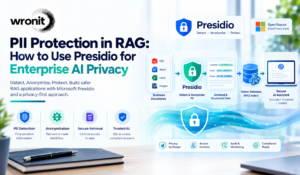
Presidio provides components for identifying sensitive entities and applying configured transformations to them. Its Analyzer detects candidate entities, while its Anonymizer transforms the detected text according to the application’s rules.
The Analyzer can use recognizers based on patterns, contextual logic and named entity recognition. Organizations can combine standard recognizers with custom rules for identifiers specific to their own systems.
 For example, a support ticket may contain a person’s name, an email address and a customer reference number. If the purpose of indexing the ticket is to retrieve a troubleshooting procedure, those identifiers may be unnecessary.
Presidio can help replace detected values with labels such as
<PERSON>, <EMAIL_ADDRESS> or a custom <CUSTOMER_ID> token. The resulting passage can retain the technical issue and its resolution while reducing unnecessary exposure of direct identifiers.
However, PII detection is not a guarantee that all sensitive information has been removed. Recognizers may miss information or incorrectly flag ordinary text. Presidio’s own documentation recommends evaluating and customizing recognizers for the target data.
Where Should PII Protection Sit in a RAG Architecture?
PII protection should cover the entire information path, from source documents through retrieval and generation to retained operational data.
A practical architecture follows this sequence:
Source documents → Text extraction and OCR → PII detection → Transformation and validation → Chunking and embedding → Permission-aware retrieval → Model context checks → Response validation → Controlled logging
Each stage has a separate responsibility.
Presidio’s standard text Analyzer operates on supplied text. PDF parsing, document structure extraction and OCR must happen before that text can be analyzed.
A document-processing tool such as Docling can help extract text and structure from supported documents. OCR may be needed for scanned pages.
If an external OCR service receives the original document, the information has already crossed that service boundary before Presidio can sanitize the extracted text. That transfer must be considered in the data-handling design.
Run detection on the extracted text and apply the configured treatment for each entity category. Validate the transformed content before it is approved for chunking and embedding.
The original source file should remain under appropriate access restrictions. Sanitizing extracted text does not remove personal information from the original PDF, screenshot or attachment.
Source previews, downloads and citation links therefore need their own authorization checks. Where required, generate a separately redacted version for display.
3. Enforce permissions during retrieval
Redaction and access control solve different problems.
Removing a customer’s name does not make a confidential support ticket appropriate for every employee. The retrieval system must still determine which documents the current user is authorized to access before their content reaches the language model.
Wronit’s guide to enterprise RAG security, permissions and data residency explains why these restrictions must extend to retrieved passages, citations, cached answers and retained conversation history.
4. Check responses and protect operational data
A final response check can identify sensitive information that should not be returned to the user. Where the application requires a complete response scan, it must hold the response until validation finishes; unrestricted token streaming can expose text before a final scan has a chance to intervene.
Logs, traces, caches and error messages also need controls. Otherwise, identifiers removed from the searchable corpus may still appear in telemetry.
OWASP’s RAG Security Cheat Sheet provides additional guidance for securing ingestion, retrieval, output validation and monitoring.
The appropriate transformation depends on why the information is needed and whether the original value must ever be recovered.
Method
|
What it does
|
Appropriate consideration
|
| Replacement |
Replaces a detected value with a label such as <EMAIL_ADDRESS> |
Useful when identity is unnecessary for the retrieval task |
| Removal |
Deletes the detected value |
Suitable when the information has no continuing purpose |
| Masking |
Hides part or all of the value |
May be useful for display, but remaining characters can still reveal information |
| Hashing |
Converts a value into a hash representation |
Requires careful treatment of salt, consistency and re-identification risk |
| Encryption |
Protects a value using cryptographic transformation |
Recovery requires controlled key management and authorization |
| Pseudonymization |
Substitutes a value with a controlled token |
May preserve relationships while keeping the identity mapping separate |
Presidio supports multiple anonymization operators, but the application must configure them to match the intended use.
A common mistake is treating replacement as proof of anonymity. If two people are both replaced with <PERSON>, the system may lose information about who acted. Conversely, a detailed incident narrative may still identify someone even after their name and email address have been removed.
When consistent identity linkage is necessary, a controlled pseudonymization service may be more appropriate. Its mapping should be protected separately, with strict access controls and tenant isolation. Do not store the identity mapping alongside the transformed text in the same broadly searchable corpus.
A Practical Example: Sanitizing a Support Ticket
Consider this synthetic example, created to illustrate a transformation policy. It is not a real customer record or verified Presidio output.
Before processing:
Maya Rao, email maya.rao@example.com, customer CUST-00421, reported error E407 after a password reset. The resolution was to revoke the previous session and retry authentication.
Intended transformed text:
<PERSON>, email <EMAIL_ADDRESS>, customer <CUSTOMER_ID>, reported error E407 after a password reset. The resolution was to revoke the previous session and retry authentication.
The transformed passage retains the error code and resolution. Those details may be sufficient to answer a question such as, “How was E407 resolved after a password reset?” The person’s direct identifiers are no longer needed for that task.
The custom customer-ID recognizer must still be tested separately. A pattern that detects CUST-00421 may also match a product code or unrelated reference number.
The remaining narrative also requires review: a rare event combined with a location, job title or exact timestamp may still identify an individual. Depending on the use case, the system may need to generalize or exclude that information.
How Should Teams Customize and Evaluate Presidio?
A reliable implementation starts with a reviewed sample of the organization’s actual data types, not a generic list of PII categories.
Standard recognizers may cover familiar entities, but company-specific account numbers, case references or internal identifiers can require custom recognizers and contextual rules. Language-specific detection also needs dedicated evaluation; selecting a language parameter does not establish that a recognizer performs adequately for that language.
Teams should measure at least two detection metrics:
- Recall: How much of the PII identified in a reviewed reference set was detected?
- Precision: How much of the content flagged as PII was correctly identified?
Higher recall can reduce missed identifiers, but overly aggressive detection may remove product codes or technical details needed for useful answers. Precision and recall should therefore be evaluated by entity type, language and document category.
The wider RAG evaluation must also test whether sanitization preserves answer quality. Compare the original and transformed workflows using the same questions, embedding model, retrieval settings and answer-generation configuration.
A useful evaluation matrix includes:
Test area
|
Evidence to collect
|
| PII detection |
Reviewed reference spans, recall, precision and sample size |
| Residual exposure |
Checks of indexed text, metadata, prompts, responses and logs |
| Retrieval quality |
Whether the transformed knowledge still retrieves required evidence |
| Answer quality |
Correctness against held-out questions and verified sources |
| Access isolation |
Tests across users, roles and tenants, including revoked permissions |
| Failure handling |
Behavior when detection, OCR or validation services fail |
| Runtime impact |
Added latency, throughput, review workload and operating cost |
Do not rely solely on running the same detector again over transformed text. The same recognizer can repeat its original mistake. Use independently reviewed samples and targeted tests for known failure cases.
Wronit’s LLM evaluation and AI safety framework offers a broader view of testing retrieval quality, answer grounding, security and robustness.
What Can Go Wrong in Production?
The most important failure modes are not limited to missed names or email addresses.
An identifier can be split across text-processing windows. OCR can misread a character. A custom recognizer can miss a new identifier format. A transformation can remove technical context required to resolve a support issue.
Operational controls matter as well. If the PII detection service times out, the application should follow a defined safe failure or review path rather than silently sending unvalidated content onward. Presidio’s REST endpoints do not provide built-in authentication, so deployed services need suitable protection through an API gateway, reverse proxy, service mesh or equivalent infrastructure.
Organizations should also test permission changes, cross-tenant requests, direct citation access and attempts to elicit hidden details through adversarial prompts. Sanitization reduces unnecessary exposure; it does not replace authorization or application security.
For teams preparing enterprise datasets and ingestion workflows, Wronit’s data engineering services can be a relevant starting point for discussing data preparation, validation and pipeline controls.
FAQs
Does Presidio guarantee that all PII will be removed?
No. Presidio uses configurable detection methods that can produce false positives and false negatives. Test it against representative data and supplement automated detection with additional controls appropriate to the risk.
Should PII be removed before generating embeddings?
When the embedding index does not need direct identifiers, detecting and transforming unnecessary PII before embedding can reduce its presence in downstream searchable content. The original documents, access rules and any retained copies still require separate protection.
Is pseudonymization the same as anonymization?
No. Pseudonymization replaces direct identifiers with tokens or other values that may be linked back to a person through separately held information. It does not automatically make the underlying record anonymous.
Can Presidio protect a RAG system by itself?
No. It can support PII detection and transformation, but the complete application also needs authorization, secure document handling, output checks, failure handling and protection for logs and caches.
Can Presidio be used with multilingual documents?
Presidio supports configurable recognizers and language-related options, but performance depends on the selected NLP models, recognizers and data. Evaluate each language and mixed-language document type separately before relying on the results.
How should an enterprise prove that PII protection is effective?
Use a reviewed reference set, report detection precision and recall, inspect downstream storage and model inputs, and test retrieval and answer quality. Record the sample size, evaluation method, baseline and operating impact. Do not treat a finite test with no observed leaks as a guarantee against future disclosure.
Plan PII Protection Before Expanding Enterprise RAG
A privacy-aware RAG system needs to preserve useful operational knowledge while limiting unnecessary exposure of personal information. Presidio can support that objective when detection, transformation and validation are designed around the data the application actually processes.
The complete design must also account for original documents, OCR, embeddings, access permissions, prompts, responses, logs and failure paths. The right evaluation measures both privacy outcomes and whether users can still obtain accurate, evidence-supported answers.
Talk to Wronit about assessing PII exposure risks and defining the controls needed for your enterprise RAG workflow. Start with a representative document sample, the questions users need answered and the privacy requirements the application must satisfy.
#AI Security#AI Security / Governance aur Data Privacy#Governance aur Data Privacy#PII Protection#PII Protection in RAG#PII Protection RAG