Enterprise AI security is becoming harder to treat as a theoretical risk. Recent incidents involving AI agents interacting with connected systems have reinforced a practical concern for enterprise buyers: once AI can retrieve, reason over, or act on business data, the application—not the prompt—must enforce permissions and trust boundaries.
Retrieval-augmented generation, or RAG, gives a language model relevant information from external sources before it answers. That can improve accuracy and usefulness, but RAG itself does not determine who can see the underlying information.
 For an enterprise RAG system, the critical security question is simple: can the assistant retrieve only the information the current user is authorized to access? Those restrictions must remain effective across retrieval, generation, citations, caches, logs, and conversation history. Data location should be assessed separately by verifying where each service stores and processes information.
For US and UAE businesses evaluating an internal AI assistant, one of the most useful security tests is straightforward: let two users with different permissions ask the same question and confirm that each receives only the information they are actually allowed to see.
For an enterprise RAG system, the critical security question is simple: can the assistant retrieve only the information the current user is authorized to access? Those restrictions must remain effective across retrieval, generation, citations, caches, logs, and conversation history. Data location should be assessed separately by verifying where each service stores and processes information.
For US and UAE businesses evaluating an internal AI assistant, one of the most useful security tests is straightforward: let two users with different permissions ask the same question and confirm that each receives only the information they are actually allowed to see.
What must RAG access control protect?
Suppose an assistant searches company policies, customer documents and internal project records. An employee may be allowed to read the general policy but not a restricted customer agreement.
The restriction needs to hold across the complete request, including search results, text passed to the model, the answer, citations and stored history. Hiding a link after restricted text has already entered the generation context is too late to satisfy that requirement.
Microsoft documents several approaches to document-level access in Azure AI Search. These include application-managed security filters and identity-aware capabilities, some of which are marked as preview. Their availability and guarantees must be checked separately. Microsoft: Document-level access control
The architectural requirement is authorization before unauthorized content crosses the relevant trust boundary. The implementation may differ by platform.
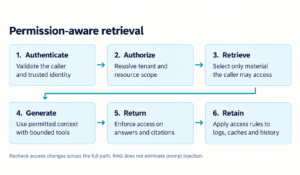
A permission-aware retrieval path
Use the following sequence as a design review, adapting it to the chosen products:
- Authenticate the caller. Establish identity from a validated session or token.
- Resolve authorization. Determine the allowed tenant, account, groups, and resource scope through trusted application logic.
- Select authorized source material. Apply the access decision before restricted chunks reach the model or an unauthorized user.
- Generate with permitted context. Keep retrieved content separate from application instructions.
- Return a supported answer. Ensure citations, previews, and downloads respect the same access decision.
- Store only approved telemetry. Apply retention and access rules to logs, caches and conversation records.
Do not accept an arbitrary group or tenant ID from the browser and assume it proves membership. Microsoft’s security-filter pattern performs string matching; the filter itself does not authenticate the principal. Your trusted backend must establish which identities and permissions can populate it. Microsoft: Security filters
What happens when permissions change?
Permissions are a lifecycle problem. A document may be reclassified, a contractor may leave, or an account team may change.
Record how those changes reach every derived representation: extracted text, chunks, embeddings, cached results and conversation context. Set a maximum permitted authorization-update delay for the workflow and measure it. A daily refresh is not sufficient if your access-revocation requirement is immediate.
Where immediate enforcement is required, the system may need a current authorization check or a mechanism that prevents stale copies from being served while updates propagate. The appropriate design depends on the source and retrieval platform.
During procurement, ask the supplier to revoke a test user’s access while the assistant is running. Repeat the query, revisit a citation and reopen the conversation. Check the actual behavior instead of accepting a diagram as evidence.
Can RAG prevent prompt injection?
No. A retrieved document can contain text that attempts to redirect the model’s behavior. RAG provides context; it does not make that context trustworthy as an instruction source. OWASP explicitly identifies indirect prompt injection through external content and states that RAG does not fully remove that risk. OWASP: Prompt injection
Treat source material as data. Keep credentials out of model context, restrict available operations, validate tool inputs in code, and evaluate adversarial documents. For an assistant intended only to answer questions, exposing unrelated write-capable tools creates avoidable authority.
A document that says “send this file elsewhere” must not gain the authority to do so. Evaluate the enforcement boundary: can the proposed action pass the application’s permission checks? A prompt telling the model to behave is not a substitute for that check.
Does local hosting guarantee local AI processing?
No. Separate the location of the application from the locations of model inference, search, content extraction, telemetry, support access, and disaster recovery.
As of 25 September 2026, Microsoft’s cross-region geography table for the Power Platform Copilot and generative AI features covered by that documentation lists the US for Azure OpenAI Service and Bing Search against UAE-hosted environments. Actual movement depends on the enabled features, availability, and data-movement settings. Verify the tenant’s configuration. This table does not describe every Azure service or every AI deployment in the UAE. Microsoft: Geographic data movement
Copilot Studio’s separate data-location documentation also describes exceptions involving support, recovery and other processing. The environment region alone therefore does not answer the whole procurement question. Microsoft: Copilot Studio data locations
US buyers should apply the same reasoning. An agreement about US storage should be checked against the actual processing chain and any feature-specific exceptions.
Ask for a data-flow inventory:
Component
|
Evidence to request
|
| Source systems |
Location, owner and permission model |
| Extraction and indexing |
Processing location, retained copies and deletion behavior |
| Model inference |
Deployment type, permitted processing geography and retention settings |
| Search and reranking |
Service location and information sent to each component |
| Logs and monitoring |
Stored fields, access, location and retention |
| Backup and support |
Recovery locations and access conditions |
Have the appropriate security and legal owners map these facts to the company’s contractual and applicable requirements. A hosting label is not a compliance conclusion.
Which acceptance tests should a buyer request?
The following is a proposed test matrix. Use controlled documents and accounts with known permissions; it is not a claim that passing a small test set proves complete security.
Test
|
Expected behavior
|
| User A can read a document; User B cannot |
Only User A receives its restricted content |
| Access is revoked after indexing |
Access stops within the explicitly agreed enforcement requirement |
| A cached answer contains restricted data |
The cache cannot disclose it to an unauthorized user |
| The same question is asked in another language |
The access decision remains unchanged |
| A document contains hostile instructions |
It cannot expand tool permissions or authorize an action |
| A source is deleted |
Retrieval and retained copies follow the agreed deletion policy |
| The permission service is unavailable |
The system follows a documented safe failure behavior |
| A citation is opened directly |
The destination enforces the user’s access |
Test conversations as well as single requests. Information may already exist in earlier messages, summaries, or exported transcripts. Define what can be retained after a role change rather than assuming fresh retrieval covers those copies.
For English-and-Arabic deployments, include both languages and mixed-language queries in the test set. This checks the implementation under the way people actually use it; it does not imply that language changes authorization rules.
What should the security handover include?
Request the identity design, data-flow inventory, permission mapping, test results, retention settings, incident owner, and recovery procedure. Record the product editions, API versions, and preview features on which the solution depends.
Connect those controls to Wronit’s broader AI governance and compliance service and its LLM evaluation guide. The specific tests here complement general governance by asking what happens to an individual document and user.
FAQs
Are role-based permissions enough for an enterprise RAG assistant?
Only if they accurately represent the source system’s authorization requirements. Some content needs account, tenant, project or document-specific rules. Test the actual access relationships and updates rather than assuming a few broad roles reproduce the source permissions.
Does encryption solve unauthorized retrieval?
Encryption protects data in particular storage and transport contexts. It does not decide whether a successfully authenticated employee is entitled to a particular document. Authorization must still be enforced by the retrieval and application design.
Can an assistant use a single shared search index?
A shared index can be an option when the system reliably enforces the required isolation and access rules. Separate indexes may be appropriate for other requirements. Ask the supplier to justify the choice and demonstrate cross-user and cross-tenant negative tests rather than equating either topology with security.
Define the access model before the rollout
Bring a list of document sources, user groups, and processing-location requirements. Contact Wronit to discuss how those constraints should shape the scope of an enterprise knowledge assistant.
#AI Security#Enterprise AI RAG Security#Enterprise RAG Security#RAG Security
ABOUT THE AUTHOR
AUTHOR
Maneesh Jha is an enterprise technology professional with 13+ years of experience spanning AI, Machine Learning, Data Engineering, Cloud, Automation, and Software Product Development. He helps businesses and startups navigate complex technology challenges, build scalable solutions, and turn emerging technologies into meaningful business outcomes.