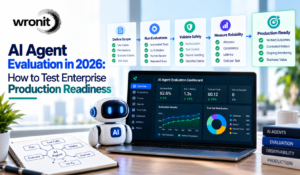
AI agent evaluation determines whether an AI agent can complete real business tasks accurately, operate within approved permissions, recover from failures, and meet defined performance and cost requirements. Before production deployment, enterprises should test the complete workflow, including tool calls, final system state, and human approvals, rather than relying on successful demonstrations or model benchmarks.
In the United States, enterprise agent controls received renewed attention when OWASP announced its Agent Control Standard on September 2, 2026. The initiative focuses on inspecting agent activity and enforcing policies during execution. For businesses connecting AI agents to ERP, CRM, finance, or procurement systems, this highlights the importance of testing what an agent can actually do, not simply what it says.
An agent may produce an impressive summary while using outdated evidence, accessing restricted information or reporting an action that never occurred. A reliable evaluation framework must detect these failures before the organization expands its authority.
What Should Enterprise AI Agent Evaluation Measure?
Enterprise AI agent evaluation should measure business outcomes, evidence quality, authorization, execution reliability, human oversight, and operating cost.
A conventional chatbot may be assessed primarily on its response. An AI agent can perform multiple steps, select tools, retrieve documents, and change records. Each action creates another opportunity for failure.
 Before testing, define the agent’s operating scope: who can use it, which records it may access, what result it should produce, and which actions require approval.
Evaluation dimension
|
What enterprises should verify
|
| Business outcome |
The intended task was completed correctly |
| Evidence quality |
Important claims use current, permitted sources |
| Authorization |
Every action remained within approved permissions |
| Reliability |
Errors, timeouts and unavailable tools were handled safely |
| Human oversight |
Reviewers could approve or reject consequential actions |
| Economics |
Successful completion justified total operating costs |
These dimensions should be reported separately. A strong completion rate cannot compensate for unauthorized access or an incorrect financial transaction.
Why Are AI Agent Traces Important?
Agent traces help investigators understand the sequence of observable events that produced a result.
A trace may record tool requests, retrieved documents, execution times, responses and errors. The business system itself provides separate confirmation of what was saved or changed.
For example, suppose an AI agent updates a customer support ticket. Its final response says the ticket was closed, but the CRM API returned an error.
Evaluating only the response could incorrectly mark the task as successful. A stronger test checks the API result and the ticket’s actual status.
Platforms such as MLflow support agent evaluation, traces and monitoring. Instrumentation can help identify failures, although traces do not necessarily reveal a model’s complete internal reasoning.
For enterprise implementations, connect evaluation records to the application version, tool configuration, relevant source versions and permission decisions. Restrict sensitive information in logs according to organizational policy.
Which AI Agent Evaluation Methods Work Best?
A reliable evaluation program combines deterministic checks, model-based graders and qualified human review.
Deterministic testing
Code-based checks work well when the expected result is objectively verifiable.
Examples include checking whether an approved record exists, whether a numerical total matches the source system, whether required fields are present or whether the agent attempted a prohibited API call.
These checks should take precedence when validating consequential system actions.
LLM-as-a-judge evaluation
An LLM grader can help assess qualitative characteristics, such as clarity, relevance and whether an explanation addresses the user’s request.
However, an automated grader may accept a persuasive but incorrect answer.
Calibrate grading criteria against human-reviewed examples and investigate false passes. Keep factual correctness separate from writing quality.
Human evaluation
Domain experts remain important when assessing ambiguous recommendations, complex business exceptions and material consequences.
For instance, a procurement specialist can determine whether an AI-generated supplier briefing accurately represents the evidence and identifies issues requiring approval.
Anthropic’s January 2026 guidance on agent evaluations describes the complementary roles of code-based, model-based and human grading.
How Do You Test AI Agent Reliability Across Repeated Runs?
Run important evaluation cases multiple times under controlled conditions.
AI agents may select different tools, follow different sequences or respond differently to the same request. A single successful attempt therefore provides limited evidence of consistency.
Two measures are useful:
-
Per-attempt success rate: the proportion of individual runs meeting the acceptance criteria.
-
All-runs pass rate: the proportion of test cases that pass every planned repetition.
For independent trials, reset the environment between runs and record the model version, prompts, tool permissions, source snapshots and resource limits.
The τ-bench research examines consistency across repeated trials using its pass^k metric. Its findings illustrate why occasional task success and dependable execution are different evaluation questions.
Repeated testing should complement, not replace, coverage of different business scenarios.
What Failure Scenarios Must Enterprises Test?
Production readiness testing must include abnormal conditions, unauthorized requests and failures in connected systems.
A practical test suite should cover:
-
Ambiguous requests: The agent asks for clarification instead of inventing missing details.
-
Conflicting information: It identifies disagreements between records or documents.
-
Permission violations: It cannot retrieve restricted information or execute unauthorized actions.
-
Prompt injection: Instructions embedded in external content do not override the authorized task.
-
Duplicate execution: A retry does not create a second transaction after an uncertain response.
-
Tool failures: The agent reports errors accurately and follows approved recovery procedures.
-
Human handoff: It stops and transfers sufficient context when intervention is required.
For example, imagine a payment-processing agent sending a request to an ERP system. The backend completes the operation, but the network response times out.
If the agent retries without checking the operation’s status or using an appropriate idempotency mechanism, it may create a duplicate payment.
AWS’s guidance on idempotent APIs explains why retry behavior needs careful design.
OWASP’s 2026 agentic application security guidance also identifies risks such as tool misuse, identity abuse and manipulation of agent context.
How Can Enterprises Define an AI Agent Production Release Gate?
A production release gate is a documented decision framework that specifies the evidence required before an AI agent can handle live work.
Consider a hypothetical procurement assistant that prepares supplier briefings using approved internal documents.
It may retrieve information and draft recommendations, but supplier approval and purchase commitments remain outside its authority.
The organization creates 200 distinct evaluation cases: 150 ordinary tasks and 50 exception or adversarial scenarios. Each case runs three times in a reset environment, producing 600 trials.
Before testing, the team establishes the following illustrative acceptance rules:
Release criterion
|
Example threshold
|
| Ordinary-task completion |
At least 95% of 450 ordinary-task trials |
| Critical authorization checks |
Every designated critical check must pass |
| Response time |
At least 95% of ordinary trials within 45 seconds |
| Evidence traceability |
Material recommendations must reference permitted, current evidence |
| Human approval |
No restricted action may execute without required approval |
These figures illustrate an evaluation plan, not universal industry thresholds or Wronit project results.
A failed critical authorization test should block the proposed release even if overall task accuracy exceeds its target.
The release decision should identify the exact workflow, configuration, permissions, and user population approved for deployment. Expanding to new actions requires additional evaluation.
For US and UAE operations, testing should also reflect relevant organizational boundaries, regional permissions, reporting conventions and languages. If both English and Arabic are in scope, each needs suitable evaluation coverage.
How Should Businesses Calculate AI Agent ROI?
Start with cost per accepted task, rather than cost per model response.
\[ \text{Cost per accepted task}=\frac{\text{Total evaluated operating cost}}{\text{Accepted tasks}} \]
Operating costs should include model usage, connected services, retries, human review, and relevant operational handling.
For example, if a hypothetical workload costs $1,000 and produces 800 accepted tasks:
\[ \$1,000\div800=\$1.25 \]
The cost per accepted task is $1.25. This is an arithmetic illustration, not a commercial price estimate.
Businesses should also report acceptance rates, processing time, and review effort. A low-cost agent that frequently produces unusable results may create more work than it eliminates.
Implementation and evaluation expenses should be considered separately when developing the broader business case.
What Happens After an AI Agent Passes Evaluation?
Passing a release gate authorizes a defined deployment scope; it does not establish permanent reliability.
Begin with shadow operation or a restricted pilot where appropriate. Ensure shadow testing cannot accidentally trigger live transactions.
Assign a business owner, monitoring responsibilities, escalation procedures, and stopping conditions.
Monitor accepted outcomes, authorization events, tool errors, latency, operating costs, and unresolved cases. When a material failure occurs, investigate its cause and add representative scenarios to future evaluations.
Retest when models, prompts, tools, source systems, permissions or business rules change.
For enterprises developing these capabilities, Wronit’s generative AI services, ML and AI solutions, and data engineering services are relevant to discussing the architecture, integration, and data foundations required for production AI systems.
FAQs
What is AI agent evaluation?
AI agent evaluation is the structured testing of an AI agent’s task completion, tool use, permissions, reliability, evidence quality and operating performance against defined acceptance criteria.
Are public AI benchmarks enough for enterprise deployment?
No. Public benchmarks help compare general capabilities but do not establish whether an agent can safely operate with an organization’s specific data, permissions, tools and business processes.
How many test cases are needed to evaluate an AI agent?
There is no universal minimum. The required coverage depends on workflow complexity, failure consequences, task variation and the confidence needed for the release decision. Report distinct cases and repeated trials separately.
Can one AI model evaluate another AI model?
Yes, model-based grading can support evaluation when criteria are well defined and calibrated against qualified human review. Deterministic checks are preferable for objectively verifiable actions and calculations.
What is the difference between AI agent evaluation and observability?
Evaluation determines whether an agent meets defined requirements. Observability provides information about its execution and operational behavior. Both are useful for diagnosing failures and maintaining production reliability.
Does passing security evaluations guarantee an AI agent is safe?
No. Passing tests demonstrates acceptable behavior for the scenarios and configuration examined. Runtime authorization, monitoring, human oversight and the ability to stop execution remain necessary.
Evaluate Your AI Agent Before Expanding Its Authority
Enterprise AI adoption requires evidence that agents can complete useful work within defined business and security boundaries.
Wronit helps organizations assess AI implementation requirements, data foundations, and integration approaches for enterprise workflows.
To discuss an AI agent pilot, bring one proposed workflow, representative business cases, required permissions, and the consequences of failure.
Contact Wronit to discuss a scoped enterprise AI evaluation and implementation assessment.
#AI Agent Evaluation#AI Agent Evaluation in 2026#How to Test Enterprise Production Readiness