AI customer service is moving quickly from experimentation to operational investment in the United States, but businesses still need to prove that automation is actually resolving customer problems—not simply responding faster. Gartner reported in August 2026 that AI spending among customer service leaders had increased 38%, while overall service and support budgets grew only 2%, increasing pressure on teams to demonstrate measurable business value from AI investments. Gartner
For an AI customer-support pilot, success should mean that a clearly defined group of customer issues is resolved accurately from start to finish, with reliable human handoff whenever automation cannot complete the request. Businesses should measure verified resolution rates, repeat contacts, customer experience, escalation quality, and total handling cost. A fast response, closed chat or low escalation rate alone does not prove that the customer’s problem was actually solved.
 That distinction becomes critical when a support leader is deciding whether to move an AI assistant from a limited demonstration into a live customer-service channel. A model may produce a convincing answer while still failing to authenticate the customer, apply the correct policy version, complete the required action or transfer an unresolved case to the appropriate team. Gartner’s 2026 customer-service research also found that customers expect access to a human agent when companies use AI for support, reinforcing the importance of designing escalation and handoff into the pilot itself. Gartner
The pilot therefore needs to test the complete customer-support journey, not just chatbot response quality. The following four-stage framework is designed for US and UAE businesses evaluating AI customer support automation, from defining eligible cases and establishing resolution criteria to validating handoffs, customer outcomes and business economics.
That distinction becomes critical when a support leader is deciding whether to move an AI assistant from a limited demonstration into a live customer-service channel. A model may produce a convincing answer while still failing to authenticate the customer, apply the correct policy version, complete the required action or transfer an unresolved case to the appropriate team. Gartner’s 2026 customer-service research also found that customers expect access to a human agent when companies use AI for support, reinforcing the importance of designing escalation and handoff into the pilot itself. Gartner
The pilot therefore needs to test the complete customer-support journey, not just chatbot response quality. The following four-stage framework is designed for US and UAE businesses evaluating AI customer support automation, from defining eligible cases and establishing resolution criteria to validating handoffs, customer outcomes and business economics.
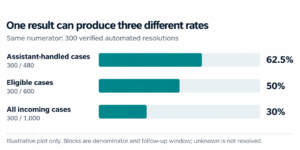
The same verified result expressed against three different denominators.
Stage 1: Define which requests the pilot is allowed to handle
Choose a small set of support intents with identifiable outcomes. Examples might include explaining a published policy, checking an authenticated customer’s order status, or collecting the information needed for a service request.
Treat these as separate capabilities. Explaining a refund policy is different from authorizing a refund. Creating a support ticket is different from resolving the problem recorded in it.
Write a scope card for each intent:
Field
|
Example for an order-status request
|
| Eligible user |
Authenticated customer linked to the order |
| Required information |
Order reference and approved account context |
| Authoritative source |
Current order and shipment systems |
| Allowed response |
Supported status and next available step |
| Excluded action |
Changing delivery details without a separate approved flow |
| Handoff condition |
Conflicting records, missing authorization or unavailable system |
| Evidence of completion |
Correct information delivered, with the agreed outcome check |
For every included intent, define an exclusion. This makes the pilot easier to assess and prevents teams from silently adding responsibilities when users ask for more.
Stage 2: Build the test set from real support patterns
Use appropriately handled historical examples, helpdesk categories, and support-team knowledge. Remove unnecessary personal information and keep the evaluation set under the company’s access rules.
Include ordinary requests and difficult cases: incomplete identifiers, outdated policies, conflicting documents, account mismatches, unavailable APIs, and customers who want a person immediately.
Test the exact deployment languages. For a UAE operation serving customers in English and Arabic, include mixed-language messages, product terminology, and realistic variations in how customers describe the same issue. For a US operation, select additional languages from its actual customer demand rather than assuming English is sufficient.
Check feature-level language support in the chosen platform. Microsoft’s Copilot Studio documentation distinguishes support across capabilities; a supported authoring interface does not establish equal conversational support for every feature. Microsoft: Language support
Use qualified reviewers for each tested language. A fluent-sounding translation is not proof that the answer applies the correct policy or preserves a critical condition.
Test the human handoff before testing scale
An escalation should transfer the context required for a person to continue. That can include the customer’s verified identity, intent, relevant records, attempted steps and the specific reason the assistant could not finish. Send only information the receiving team is entitled to access.
Microsoft’s generic engagement-hub pattern illustrates that handoff involves routing and an adapter that passes conversational context. It is an integration to build and verify, not merely a sentence telling the customer that someone will help. Microsoft: Generic handoff
Test an unstaffed queue as well. Decide whether the customer receives a ticket reference, a callback arrangement or a clear statement of operating hours. Do not let the interface promise an immediate transfer when no one is available.
The implementation must also distinguish a requested handoff from a successful handoff. Microsoft’s escalation documentation explains how a transfer node affects session reporting; your operational check should establish that the receiving workflow actually accepted the case. Microsoft: Live-agent handoff
Stage 3: Run a controlled pilot with defined outcome metrics
Begin with internal evaluation or a supervised release appropriate to the workflow. Move to a limited live cohort only when the agreed tests and operational requirements are met.
Use a metric definition sheet rather than relying on labels from a dashboard:
Metric
|
Suggested definition
|
Why it matters
|
| Verified automated resolution |
Eligible cases completed by automation under the agreed outcome rule |
Measures useful completion |
| Repeat contact |
Same issue returns within a defined observation window |
Detects false or incomplete resolution |
| Handoff completion |
Escalations successfully accepted by the receiving workflow |
Checks continuity of service |
| Answer correctness |
Reviewed answers meeting the policy and factual rubric |
Separates fluent writing from accuracy |
| Customer satisfaction |
Survey result with response rate and cohort reported |
Helps expose experience differences |
| Total handling cost |
Automation, review, handoff and operating cost for the cohort |
Supports a realistic business case |
These are proposed operational definitions, not universal industry standards. Adapt them to the support journey and retain the definitions when comparing results.
Platform metrics can be channel-specific. For example, Zendesk documents reporting on automated resolutions for email and web forms using a particular ticket tag. Before comparing that report with another product, check what generates the tag and whether the denominator and observation period match. Zendesk: Automated-resolution reporting
A worked example: why the denominator matters
Imagine a pilot receiving 1,000 support cases during a defined period. The following numbers are illustrative, not a Wronit result or an industry benchmark.
- 600 cases match the intents eligible for the pilot.
- 480 of those cases are actually handled by the assistant.
- After applying the outcome rule and checking repeat contacts, 300 count as verified automated resolutions.
- The remaining 180 handled cases consist of 60 handoffs and 120 cases without a verified outcome.
The resulting rates answer different questions:
- 62.5%: 300 verified resolutions / 480 assistant-handled cases.
- 50%: 300 / 600 eligible cases.
- 30%: 300 / 1,000 total incoming cases.
All three can be mathematically correct. Reporting only the first can make the effect on the whole service operation look larger than it is.
Choose and disclose the repeat-contact window. A seven-day window could be an initial assumption for one workflow, but another may require a different period. Also show how abandoned conversations and unknown outcomes are treated. Unknown should not silently become resolved.
Stage 4: Decide whether to expand, change or stop
Agree the decision rules before reviewing the pilot results. This reduces the temptation to redefine success after seeing the dashboard.
Expand an intent only when it meets its quality, access, experience and operating criteria. A strong result for policy questions does not automatically justify account changes or billing actions.
Segment the evidence by intent, language and relevant customer cohort. An acceptable overall average can conceal a weak result in a smaller group. For surveys, show the response rate and who was offered the survey; selective invitations can distort the picture.
Compare with a suitable baseline. A concurrent comparable cohort is useful where practical. If you compare before and after, record differences in demand, policy changes, staffing and case mix. Do not attribute every change to the assistant.
What should the supplier hand over?
Request the approved intent list, knowledge ownership map, integration documentation, evaluation cases, metric definitions, release criteria and escalation runbook. Establish who can disable an intent and how customers are routed when automation is unavailable.
Use Wronit’s LLM evaluation guide for broader testing considerations. The support pilot should then translate those technical checks into customer-service outcomes.
FAQs
Is chatbot containment the same as resolution?
No. A conversation may remain inside the chatbot because the user left, could not find the handoff option or received an incomplete answer. Define resolution using an outcome rule and appropriate follow-up evidence. Keep containment as a separate measure if the platform reports it.
How long should an AI support pilot run?
Long enough to collect representative cases and observe the agreed follow-up window. Calendar duration alone is insufficient. A low-volume intent or an infrequent exception may require additional evaluation cases rather than a premature conclusion from a short live sample.
Should the assistant answer in Arabic from day one?
Include Arabic when it is part of the intended customer experience and you can support the full journey: retrieval, answers, forms, and human escalation. Test it as a distinct requirement with qualified reviewers. Availability of a multilingual model is not equivalent to validated service quality.
Turn the pilot into a measurable decision
Bring your leading support intents, current handling measures and helpdesk setup. Discuss an AI support pilot with Wronit, or review its Generative AI services before preparing the brief.
#AI Automation#AI Automation Cost#AI Customer Support Automation
ABOUT THE AUTHOR
AUTHOR
Maneesh Jha is an enterprise technology professional with 13+ years of experience spanning AI, Machine Learning, Data Engineering, Cloud, Automation, and Software Product Development. He helps businesses and startups navigate complex technology challenges, build scalable solutions, and turn emerging technologies into meaningful business outcomes.