Enterprise AI assistants often struggle with information that already exists inside company documents. The challenge is not always the language model. A critical contract clause may be separated from its heading, a financial table may lose its column labels, or a scanned policy may be converted into text in the wrong reading order. When this happens, even a well-designed retrieval-augmented generation (RAG) system can generate answers that sound convincing but are factually incorrect.
For businesses developing AI-powered knowledge assistants, accurate document ingestion is an essential part of reliable enterprise Generative AI solutions. This is where Docling, an open-source document processing toolkit, can help. It converts PDFs, scanned documents, spreadsheets, and other business files into structured content, preserving important relationships between headings, tables, and text for downstream retrieval.
In this guide, we explain how Docling works, where it fits into enterprise RAG architecture, how to implement document conversion and context-aware chunking, and how to evaluate extraction quality before production deployment. We also examine practical considerations for organizations in the United States and UAE, including multilingual documents, data security, document versioning, and operational performance.
Why Document Structure Matters for Enterprise RAG
An enterprise knowledge assistant can retrieve the correct PDF and still provide the wrong answer. The problem often begins before the language model receives any information: a table is flattened, a section heading disappears, or a policy exception becomes separated from the rule it qualifies.
For organizations building document-based AI assistants, this makes ingestion quality an important engineering decision. Wronit’s Generative AI services and data engineering solutions address related requirements, including preparing enterprise information for reliable AI applications.
Docling is an open-source document processing toolkit that converts complex business files into structured representations suitable for downstream retrieval-augmented generation (RAG) workflows.
It can help preserve reading order, document hierarchy, tables, and source references that ordinary text extraction may lose.
However, document conversion is only one part of a trustworthy RAG system. Retrieval quality, access permissions, document freshness, and answer validation remain separate responsibilities.
This guide examines where Docling fits in an enterprise architecture, how to implement structure-aware chunking, and what to test before deploying it across business documents.
What Is Docling?
Docling is an open-source document processing framework originally developed by IBM Research and now maintained as a project within the LF AI & Data ecosystem.
It supports multiple document formats, including PDF, DOCX, PPTX, XLSX, HTML, and images.
Its main purpose is to transform document content into a structured representation that downstream applications can inspect, process and retrieve.
Unlike a basic text extractor, Docling can represent document elements such as headings, paragraphs, tables, pictures, and their relationships.
Its central representation is called DoclingDocument.
This representation can preserve information about document structure, reading order and source provenance, including page locations where available.
Docling supports exports such as Markdown and structured JSON.
Markdown is convenient for reviewing extracted content. JSON is more appropriate when an application needs richer structural information, metadata and references to original document elements.
The Docling codebase is MIT-licensed, although organizations should separately review licenses associated with models and optional dependencies.
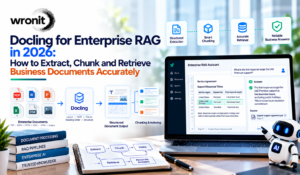 For enterprises building machine learning and AI solutions, these capabilities make Docling a candidate for the document preparation layer of a RAG application.
What Docling does not do
Docling is not a complete RAG platform.
It does not independently provide every component needed for a production knowledge assistant.
A complete system still requires embedding generation, indexing, retrieval, access control, answer generation, evaluation and operational monitoring.
Docling improves how source information is prepared for those components.
Where Docling Fits in an Enterprise RAG Architecture
A typical RAG application retrieves relevant information from approved sources and supplies that information to a language model when generating an answer.
Docling operates primarily before retrieval, during document ingestion.
The architecture can be represented as:
<box border radius=”lg” padding={3} gap={2}>
<box background=”surface-secondary” radius=”md” padding={3} align=”center”>
**Enterprise Documents**
<text size="xs" color="secondary" textAlign="center">PDFs · Word · PowerPoint · Excel · Scans</text>
</box>
<row justify=”center”><icon name=”arrow-down” color=”secondary”/></row>
<box background=”rgba(36,110,215,0.07)” border={{size:1,color:”rgba(36,110,215,0.25)”}} radius=”md” padding={3} align=”center”>
**Docling Conversion**
<text size="xs" color="secondary" textAlign="center">Layout · OCR · Tables · Reading order · Document structure</text>
</box>
<row justify=”center”><icon name=”arrow-down” color=”secondary”/></row>
<box background=”surface-secondary” radius=”md” padding={3} align=”center”>
**Quality Validation & Context-Aware Chunking**
<text size="xs" color="secondary" textAlign="center">Content checks · Metadata · Versions · Access labels</text>
</box>
<row justify=”center”><icon name=”arrow-down” color=”secondary”/></row>
<box background=”surface-secondary” radius=”md” padding={3} align=”center”>
**Embeddings & Search Index**
<text size="xs" color="secondary" textAlign="center">Vector, keyword or hybrid retrieval</text>
</box>
<row justify=”center”><icon name=”arrow-down” color=”secondary”/></row>
<box background=”surface-secondary” radius=”md” padding={3} align=”center”>
**Authorized Retrieval & Answer Generation**
<text size="xs" color="secondary" textAlign="center">Permission checks · Evidence selection · Source citations</text>
</box>
</box>
A practical workflow starts with an approved, versioned document and its access rules.
Docling converts the file into structured content. The application then checks extraction quality, creates appropriate chunks and attaches metadata needed for indexing.
At query time, the retrieval system selects information the user is authorized to access. The language model uses that evidence to generate an answer.
This separation is important because failures can originate at different stages.
A document parser may omit a table value. The search system may fail to retrieve the relevant chunk. The language model may misinterpret otherwise correct evidence.
Each failure requires a different corrective action.
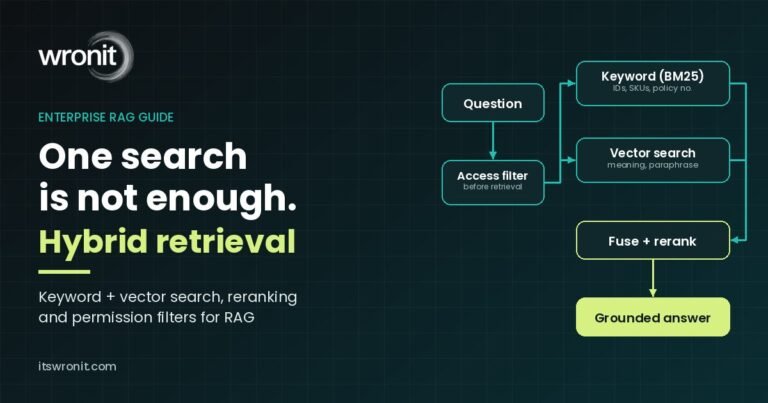
Wronit’s guide to enterprise RAG security, permissions and acceptance tests examines additional controls needed when enterprise knowledge is accessed through AI.
1. Reading order in complex documents
Business documents often contain multiple columns, sidebars, headers and footnotes.
A simple extraction process may combine text in an incorrect sequence.
Consider a two-column policy document. A paragraph describing eligibility appears in the left column, while an unrelated exception appears in the right.
If the extraction interleaves both columns, the resulting text may imply a relationship that does not exist.
Docling uses document layout information to reconstruct reading order.
This can provide a more reliable starting point for chunking, although complex layouts should still be tested against the original files.
2. Section headings and business context
A retrieved statement such as “approval is required within two business days” may be insufficient on its own.
The correct interpretation depends on the policy section, business process and relevant customer category.
Preserving section headings helps downstream systems understand the scope of a statement.
Docling can identify structural elements such as section headers. For PDF files, recovery of deeper heading hierarchy may require additional configuration and validation.
Enterprises should not assume that every converted document automatically contains a perfect heading structure.
3. Tables and relationships between values
Tables are especially important in enterprise RAG because they often contain prices, service levels, eligibility conditions and financial thresholds.
Consider the following illustrative supplier support agreement.
Service region
|
Support tier
|
First response target
|
| United States |
Premium |
4 business hours |
| United Arab Emirates |
Premium |
2 business hours |
| United States |
Standard |
1 business day |
The document also specifies that response targets exclude public holidays and refer to first response rather than issue resolution.
A user asks:
What is the first response target for UAE Premium support?
If extraction produces an isolated string containing “Premium, 4 business hours, 2 business hours,” the answer becomes ambiguous.
The retrieved evidence should preserve the region, tier, response-time column and relevant policy qualification.
The supported answer is:
The first response target for UAE Premium support is two business hours, excluding public holidays. This is not an issue-resolution commitment.
Docling can help retain the table structure needed to support that answer.
The ingestion application must still validate the extracted cells and preserve or link relevant qualifications.
This distinction matters in data analytics and reporting, where incorrect associations between labels and values can produce misleading business information.
Understanding Docling’s HybridChunker
Chunking divides document content into smaller units that can be embedded and retrieved.
A common implementation uses fixed character counts or token windows.
That approach is simple, but it may divide a table, separate a policy heading from its content or split a condition from its exception.
Docling provides structure-aware chunking capabilities.
Its HybridChunker combines document structure with tokenizer-based limits.
The process begins with structural chunks and then applies token-aware adjustments.
Oversized chunks can be divided to fit the configured token budget. Compatible neighboring chunks may be merged when they share suitable structural context.
This should not be confused with hybrid search, which combines retrieval methods such as lexical and vector search.
Why contextualized chunks matter
A short extracted statement may not make sense without its section heading.
Docling’s contextualize() method can generate text enriched with relevant chunk metadata for embedding.
For example, a chunk containing a support response time can retain the section context that identifies the applicable policy.
The tokenizer should be aligned with the embedding model used downstream.
Additional headings and metadata consume tokens, so the final contextualized text must still fit the embedding model’s limits.
There is no universally correct chunk size.
A short contract clause, a wide pricing table and a multi-page operating procedure may require different chunking strategies.
The appropriate configuration should be selected through retrieval testing.
Python Example: Converting and Chunking a PDF With Docling
The following example demonstrates how to convert a local PDF and prepare contextualized chunks for a downstream retrieval system.
Install the required packages:
python -m pip install docling transformers
Then use the following Python code:
from docling.document_converter import DocumentConverter
from docling.chunking import HybridChunker
from docling_core.transforms.chunker.tokenizer.huggingface import (
    HuggingFaceTokenizer,
)
from transformers import AutoTokenizer

model_id = "sentence-transformers/all-MiniLM-L6-v2"

tokenizer = HuggingFaceTokenizer(
    tokenizer=AutoTokenizer.from_pretrained(model_id),
    max_tokens=128,
)

converter = DocumentConverter()

result = converter.convert("supplier_policy.pdf")
document = result.document

chunker = HybridChunker(
    tokenizer=tokenizer,
    merge_peers=True,
)

records = []

for index, chunk in enumerate(chunker.chunk(dl_doc=document)):
    records.append({
        "chunk_index": index,
        "text": chunker.contextualize(chunk=chunk),
        "metadata": chunk.meta.model_dump(mode="json"),
    })

print(f"Prepared {len(records)} chunks")
This example converts a PDF into Docling’s document representation and prepares contextualized chunks.
It does not create embeddings, connect to a vector database or implement access controls.
The 128-token setting is illustrative, not a recommended universal configuration.
For production use, the application should also validate conversion status, handle failed files, preserve source identifiers and record the configuration used to generate each chunk.
The tokenizer must match the intended embedding model or be changed accordingly.
The example is intended for an English-oriented workflow. Arabic or multilingual retrieval requires separate model and tokenizer evaluation.
For official implementation details, consult the Docling chunking documentation and HybridChunker example.
Integrating Docling With LangChain and LlamaIndex
Enterprises do not necessarily need to rebuild their RAG application to evaluate Docling.
Existing ingestion components can be replaced or supplemented while retaining the current embedding, retrieval and generation architecture.
Docling provides integrations with widely used AI development frameworks.
Docling with LangChain
The LangChain integration includes DoclingLoader, which can convert source documents and expose their content for downstream processing.
Depending on configuration, applications can work with document-level exports or chunked content.
This can be useful for teams already using LangChain for retrieval orchestration.
Docling with LlamaIndex
LlamaIndex integrations allow Docling documents to be imported and processed into downstream nodes.
The application should verify that document identifiers, structural metadata and source references survive conversion into the retrieval index.
In either framework, integration success should be measured through actual retrieval and answer-quality tests.
A working connector does not establish that the system retrieves the correct business evidence.
Organizations designing custom AI applications and document intelligence solutions should evaluate these integrations against existing architecture, operational requirements and security controls.
Production Considerations for US and UAE Enterprises
Multilingual documents require separate testing
US and UAE organizations may maintain documents in English, Arabic or both languages.
Scanned invoices, bilingual agreements and regional operating procedures introduce additional complexity.
OCR performance should be evaluated against the actual document collection.
Tests should include right-to-left reading order, mixed-script tables, dates, currencies, Arabic and Western numerals, stamps and low-contrast scans.
Successful extraction from an English PDF does not establish equivalent performance on Arabic documents.
Retrieval should also be tested separately.
A document may be extracted correctly but remain difficult to retrieve when the user’s question is written in another language.
Docling supports local document processing, including configurations intended for offline environments after required model assets have been prepared.
However, local conversion does not mean the entire RAG application operates privately.
The subsequent embedding service, vector database, language model and logging infrastructure may process information in different environments.
Enterprises should evaluate the complete data path.
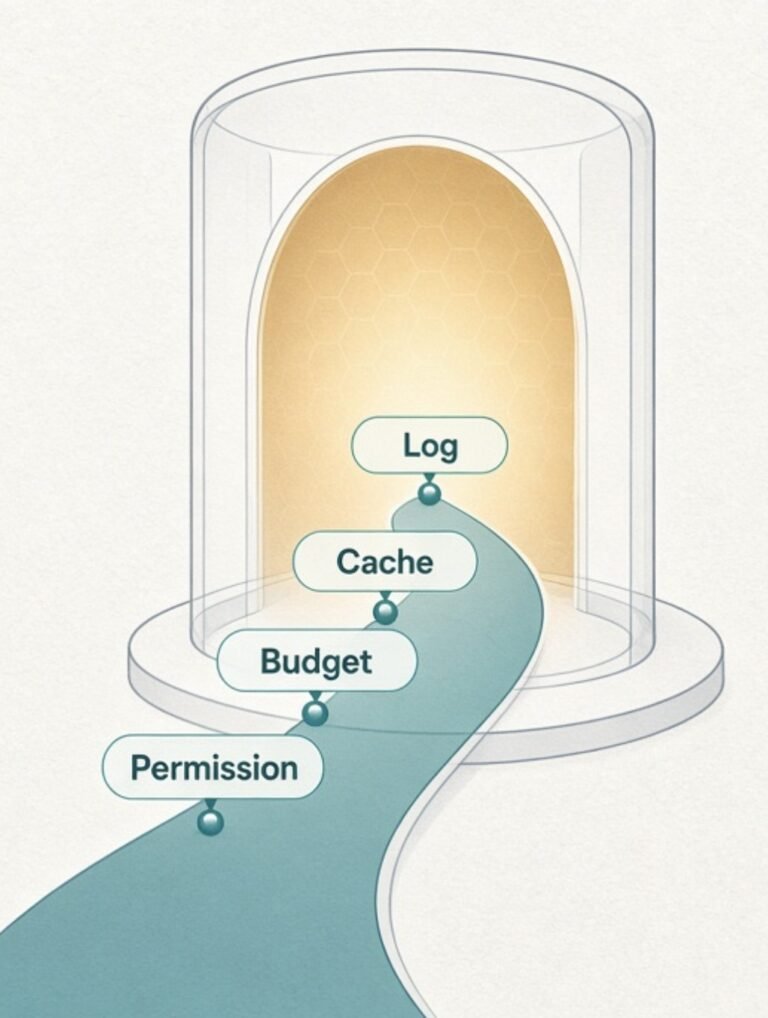
Access restrictions must be enforced during retrieval before unauthorized content enters the model’s context.
Storing an access-control label as metadata is insufficient unless the application actually applies that restriction.
Wronit’s enterprise data readiness guidance addresses related questions of data quality, availability, authorization and operational suitability.
Document versioning and ingestion reliability
Production ingestion should preserve the relationship between a source file and the chunks created from it.
Useful metadata includes the document identifier, source version, content hash, conversion settings, processing status and ingestion timestamp.
When a document changes, the application should replace the corresponding indexed version according to an approved update process.
When a document is withdrawn or access permissions change, retrieval must reflect that change.
Conversion failures should be logged and investigated rather than silently treated as successful ingestion.
These practices also connect with broader database management and data quality services, where consistency, traceability and reliable data operations are important engineering requirements.
How to Evaluate Docling Before Enterprise Deployment
A useful pilot compares the existing ingestion process with a Docling-based approach using representative documents and real business questions.
The objective is to determine whether the new ingestion approach improves the evidence available to retrieval and answer generation.
A pilot might begin with 50 documents and 100 questions, although these are illustrative planning figures rather than benchmark requirements.
The collection should include ordinary PDFs, complex tables, scanned documents, long policies and bilingual material where relevant.
Keep the embedding model, retrieval configuration and generation settings consistent when comparing ingestion approaches.
This helps isolate the impact of document preparation.
Evaluation area
|
What to measure
|
What a failure indicates
|
| Extraction accuracy |
Correct fields, text and table relationships |
Source information was lost or altered |
| Retrieval quality |
Required evidence present in retrieved results |
Relevant content was not available to generation |
| Answer accuracy |
Correct, evidence-supported responses |
The answer misinterpreted or exceeded the evidence |
| Citation quality |
References support the stated claims |
Sources are incorrect, incomplete or outdated |
| Operational performance |
Processing time, failures, memory and cost |
The configuration may be impractical at scale |
Results should be reported by document category and language.
An overall average may conceal poor performance on a smaller but business-critical collection.
For example, an ingestion process might perform well on standard text PDFs while frequently misreading financial tables.
If those tables support procurement or financial decisions, the failure may be unacceptable despite strong overall performance.
Domain reviewers should identify critical errors before testing begins.
The goal is to establish whether Docling improves the specific workflow that matters to the business.
When Should an Enterprise Use Docling?
Docling is worth evaluating when important business knowledge is stored in documents whose structure affects interpretation.
Suitable candidates include service agreements, procurement documents, technical manuals, operating procedures, regulatory documents and scanned business records.
It is particularly relevant when the existing ingestion process loses table relationships, section context or reading order.
However, Docling may not be necessary for every RAG application.
If an organization already has clean, structured text and reliable retrieval results, a simpler ingestion process may be sufficient.
Similarly, authoritative financial calculations should generally be performed through governed analytical systems rather than relying on document extraction.
For enterprises modernizing document repositories or moving AI workloads to new infrastructure, cloud data migration services may also be relevant to storage, security and deployment planning.
The implementation decision should follow the observed failure.
If the problem originates in document extraction, Docling may address an important part of the solution.
If the problem originates in stale permissions, incorrect retrieval or unsupported model conclusions, those components require separate engineering work.
FAQs
What is Docling used for in RAG?
Docling converts documents into structured content that can be inspected, chunked and indexed for retrieval. It helps preserve document elements such as headings, tables and reading order that may be important for accurate answers.
Is Docling a complete RAG framework?
No. Docling primarily supports document conversion and structured chunking. A production RAG application also needs embeddings, indexing, retrieval, access enforcement, answer generation and evaluation.
Can Docling process scanned PDFs?
Yes. Docling supports OCR-based processing. Results depend on document quality, selected OCR engine, language configuration and layout complexity.
Does Docling reduce hallucinations in enterprise AI?
It can improve the quality and structure of evidence supplied to a RAG system. However, it cannot guarantee that retrieval will select the correct information or that the language model will interpret it accurately.
What is the difference between Docling and traditional PDF text extraction?
Traditional text extraction often focuses on recovering text content. Docling additionally represents structural information such as document elements, reading order, tables and source provenance where supported.
Can Docling run locally without sending documents to a cloud service?
Docling supports local and offline conversion when the required assets are available and the environment is configured appropriately. Enterprises must separately assess whether downstream embedding, retrieval and generation services transmit information externally.
Is Docling suitable for Arabic and English documents?
It can be evaluated for multilingual collections, but extraction and retrieval quality should be tested separately for each language and document type. OCR engine capabilities and configuration are important considerations.
How should enterprises measure Docling’s effectiveness?
Compare extraction correctness, retrieval evidence coverage, answer accuracy, citation validity and operating costs against an existing ingestion process using representative documents and verified questions.
Build a More Reliable Enterprise RAG Pipeline With Wronit
Reliable enterprise RAG begins with understanding the information users need and the document characteristics that make that information difficult to retrieve.
A practical implementation should start with representative files, defined business questions and measurable acceptance criteria.
Docling can improve the document preparation stage, particularly where layout, tables and structural relationships affect interpretation.
The surrounding application must still enforce permissions, manage document versions, retrieve appropriate evidence and validate generated answers.
Wronit Technocraft supports organizations evaluating these requirements through its data engineering services and Generative AI solutions.
For enterprises and startups planning document-based AI assistants, the next step is to assess the current ingestion workflow and identify which extraction, retrieval or governance failures need to be resolved before production deployment.
A better document parser is valuable when it helps an AI system retrieve the right evidence, preserve its meaning and support answers that users can verify.
#Docling for Enterprise RAG#Docling for Enterprise RAG in 2026#enterprise RAG