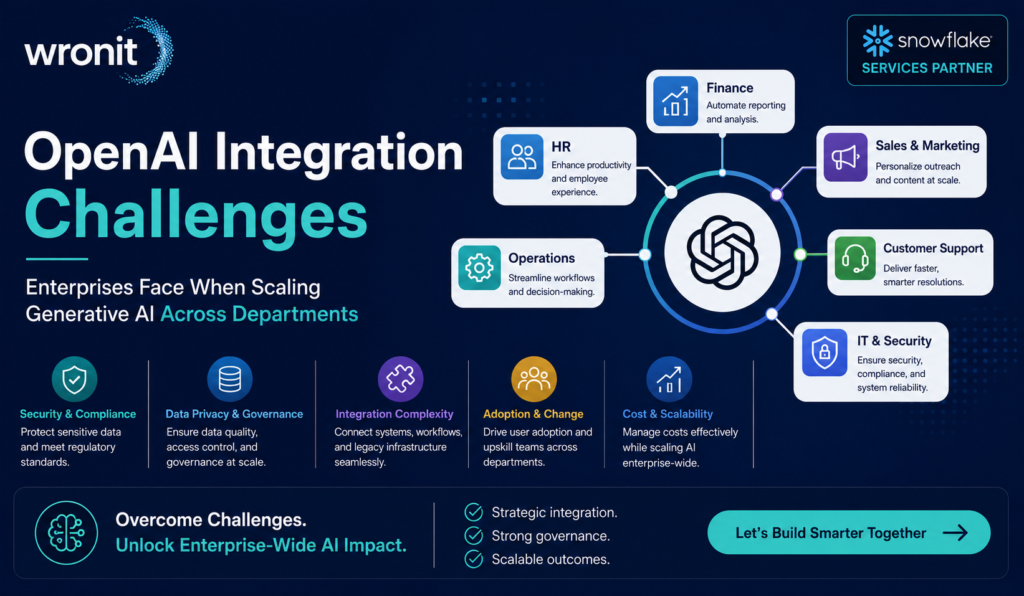
OpenAI Integration Challenges Enterprises Face When Scaling Generative AI Across Departments
By Maneesh Jha
Generative AI is rapidly moving from small workplace experiments to everyday enterprise operations across the US. In 2025, more than 1 million business customers were using its business products, according to OpenAI, a sign of how quickly organisations are adopting AI for writing, research, analysis, coding, and workflow support. At the same time, enterprise teams are starting to experiment with AI applications that can interface with internal systems, rather than simply generating responses. That creates a much bigger technology challenge.Sales, finance, HR, customer service, IT, and operations all manage different systems and different types of information. Connecting AI across these environments calls for careful consideration of APIs, security, permissions, data quality, and governance. “OpenAI integration services can enable enterprises to create these connections while building scalable AI integration, workflow automation, and data-access frameworks that enable greater adoption without sacrificing control.”
Why Scaling AI Is Harder Than Running a Pilot
A small AI experiment is relatively easy to control. A development team can connect an application to an AI model, test a few use cases, and measure the results.Enterprise deployment is different.Once several departments start using generative AI, questions about access, data, monitoring, cost, security, integration, and governance quickly become more important.Marketing may want AI to generate campaign content. Customer service may want automated responses. Finance may need document analysis. IT may want an internal support assistant.Each use case can require different data sources and permissions.The technology may be shared, but the business requirements are not.
Challenge 1: Connecting AI With Existing Enterprise Systems
Most US businesses rely on a complicated technology stack.AI may need to use information held in CRM platforms, ERP systems, HR applications, ticketing tools, databases, document repositories, and internal applications.The trick is to get those connections to work reliably.An AI assistant that can’t access current customer information might give an answer that sounds right, but is outdated. A finance tool within the organisation that is linked to incomplete information could create even bigger problems.This makes API integration a crucial part of enterprise AI architecture. Organisations want controlled connectivity between AI applications and the systems housing trusted business information.
Challenge 2: Data Is Different Across Departments
What is useful to one department may be useless to another department.Sales could work with customer accounts and pipeline data. HR manages employee information. Finance handles sensitive financial documents. Legal teams may handle confidential contractsAll AI applications have broad access to enterprise data, so the risk is unwarranted.A better way is establishing clear data boundaries. “AI applications should only have access to information necessary to perform their intended function, and permissions should be aligned to existing business rules.OpenAI says it does not use business data to train its models by default, and its business offerings include security and access management built for enterprise environments.That does not relieve the enterprise from the responsibility to design appropriate access and governance.
Challenge 3: Security Becomes More Complicated
Traditional software usually does predictable things. Generative AI understands information and can respond differently from one request to another.That has further security considerations.Organisations should consider what information goes into prompts, who can access AI applications, what tools an AI system can invoke, and what happens to generated outputs.“AI security needs to be built into the architecture design rather than added post-implementation.”Deployment plan should contain: control of access, authentication, logging, monitoring, testing, appropriate restrictions.
Challenge 4: Keeping AI Responses Grounded in Business Data
A general-purpose AI model may know a lot, but enterprise users typically want answers based on internal information.For example, if an employee asks about the company policy, they need to get the current policy of the organisation and not some generic explanation from the internet.That’s where retrieval-augmented generation (RAG) and enterprise knowledge integration can help. The model can retrieve and share pertinent internal information when responding to a request.But the quality of the answer still depends upon the quality of the underlying documents. The outcome can be impacted by old policies, duplicate files, inadequate metadata, and missing information.
Challenge 5: Different Departments Need Different AI Experiences
Rarely does one enterprise AI application fit all departments’ needs.A customer service assistant may need access to customer history and support tickets. A developer assistant might need code repositories and technical documentation. A finance application may need tight controls around sensitive information.“That’s why the generative AI integration should be focused on reusable architecture, not on forcing every department into the same workflow.”Organisations can set common security and governance standards while allowing individual teams to build applications that fit the work they do.
Common Integration Problems and Practical Responses
Enterprise challenge
Anything may happen
Practical response
Systems that are disconnected
AI doesn’t have current information
Develop managed API integrations
Bad data quality
Answers unreliable
Enhance data governance
Permission over
Sensitive data leaks
Use Role-Based Access
Ownership in doubt
No one handles AI workflows
Designate Business and Technical Owners
Conflicting prompts
Mixed results
Create reusable patterns
Increasing use
Unforeseen expenses
Track usage and set controls
Bad Test
Users encounter problems
Evaluation build pre-deployment
The key point is: you can’t scale AI just with an API key; you need an operating model.
Challenge 6: Controlling Costs as Usage Grows
AI used by 10 employees will behave differently than AI used by 10,000.The requests are growing. More documents can be processed. Larger workloads can mean more use of the model. The same job could be done by applications developed by different departments.AI spend can get hard to make sense of without visibility.AI Cost Optimisation should include usage monitoring, application-level budgets, model selection, prompt efficiency, caching where applicable, and clarity of ownership.OpenAI also offers business controls like project limits, usage dashboards, and centralised spend controls to help businesses manage usage.Enterprises should add their own financial governance on top of those platform capabilities.
Challenge 7: Measuring Whether AI Is Actually Working
A successful proof of concept is not always a successful enterprise deployment.Leaders need to know if AI is making something that matters better.Useful measurements might include:
Time saved per individual
Response time of the customer
Time to case resolution
Less repetition.
Accuracy of generated outputs
Getting the staff on board
Cost of workflow
Revenue driven by AI-assisted processes
These steps give a sharper view of AI ROI.
If an application saves employees five minutes but requires a lot of human correction, the real benefit may be a lot less than expected.
Challenge 8: Governance Across the Enterprise
Departments developing AI applications in isolation could lead to fragmentation of governance.One team may develop a tightly controlled application, while the other team may develop an application without proper review. Eventually, IT and security teams need to know dozens of different implementations.A centralised AI governance framework can set baseline requirements for security, privacy, access, testing, monitoring, documentation, and acceptable use.Teams can still innovate, but within boundaries that the wider organisation understands.
How OpenAI Integration Services Can Help
OpenAI integration services can support enterprises that need to move beyond isolated AI experiments.A structured engagement may include business use-case discovery, API integration, enterprise application development, RAG implementation, workflow automation, security architecture, evaluation, monitoring, and deployment support.The strongest approach usually starts with a small number of high-value workflows.Instead of asking, “Where can we use AI?”, leaders can ask, “Which business process is slow, repetitive, expensive, or difficult to scale?”That question tends to produce better projects.
Building a Scalable Enterprise AI Foundation
Enterprises should treat generative AI as part of their broader technology architecture.That means establishing reusable authentication, data access patterns, logging, monitoring, evaluation methods, security controls, and deployment processes.When the next department wants to introduce an AI application, it should not have to reinvent everything.A common foundation can make enterprise AI integration faster while maintaining consistent standards.
Conclusion
Scaling generative AI across a U.S. enterprise is not as simple as plugging an application into an AI model. The real work begins when that model needs access to real business data, existing applications, sensitive information, and workflows used by thousands of employees.You have to look at integration, data quality, security, governance, cost control, evaluation, and the department’s requirements.”OpenAI integration services can help organisations tackle these challenges with a structured approach to APIs, enterprise applications, data retrieval, workflow automation, security, and deployment.The companies that will get lasting value from generative AI aren’t necessarily the ones that will launch the most experiments. They will be the ones to build the foundation to turn successful experiments into secure, measurable, and repeatable business capabilities.
FAQ’s
What are the biggest OpenAI integration challenges for enterprises?
Common challenges include connecting existing systems, protecting sensitive information, managing permissions, maintaining data quality, controlling costs, and establishing consistent AI governance.
Why do enterprises need OpenAI integration services?
Specialist support can help organizations connect AI applications with business systems while addressing architecture, security, data retrieval, workflow automation, testing, and scalability.
How can companies protect data during AI integration?
Organizations should use appropriate access controls, encryption, data governance, monitoring, retention policies, and carefully designed integrations based on the sensitivity of each workload.
Can OpenAI integrations be used across multiple departments?
Yes. Enterprises can create different applications for departments while maintaining common standards for security, authentication, governance, monitoring, and data access.
How should enterprises measure generative AI success?
Measure practical business outcomes such as time saved, response speed, accuracy, employee adoption, operating costs, customer experience, and revenue impact rather than focusing only on usage numbers.
With 11+ years of experience in enterprise technology, AI, Machine Learning, Data Engineering, Cloud, Automation, and Software Product Development, he helps businesses and startups turn complex technology challenges into scalable solutions that drive innovation and growth.