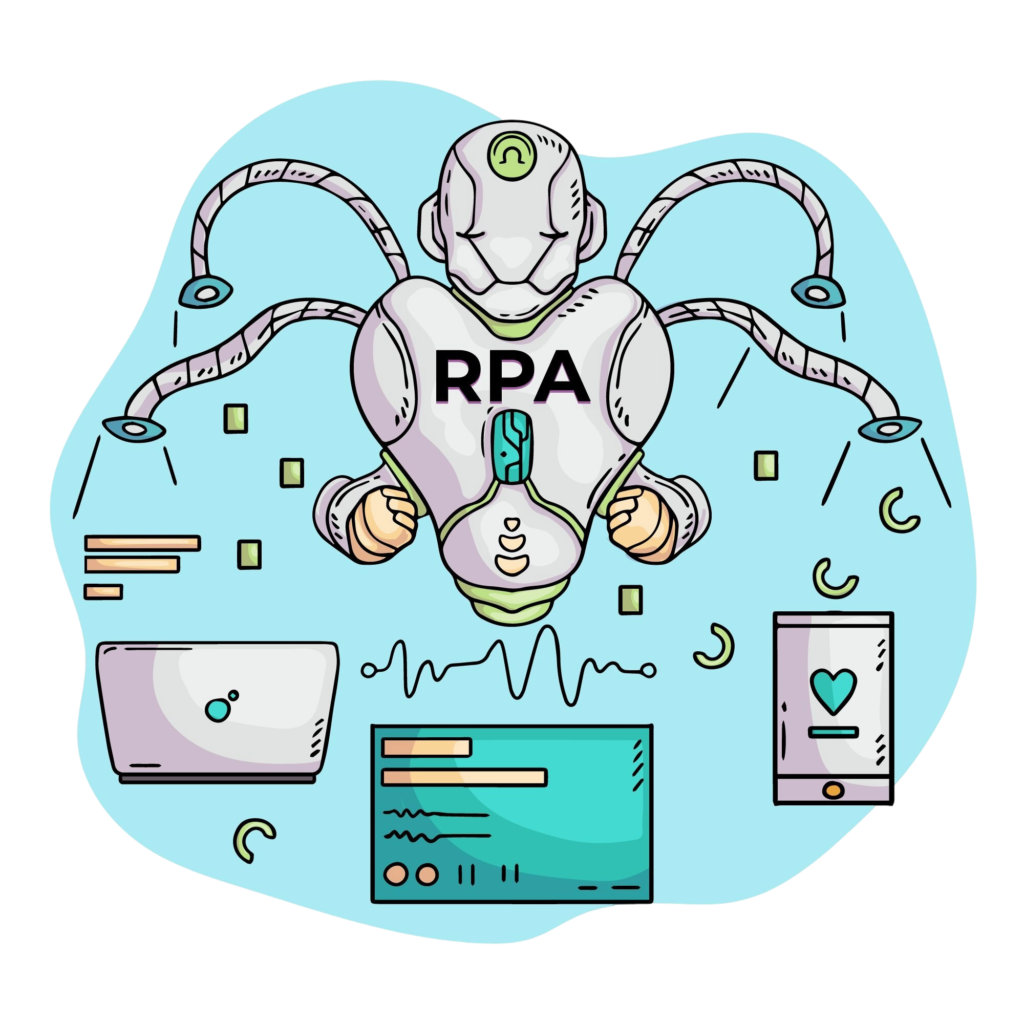
Use rules-based automation when the decisions and steps are already known, RPA when those known steps must be executed through a software interface, and AI agents when the workflow genuinely requires interpretation or a changing sequence of actions. Many enterprise processes work best with a controlled combination rather than forcing every step into one technology.
The most useful question is therefore not “AI agent or RPA?” It is “Where does uncertainty exist in this workflow, and which parts should remain deterministic?”
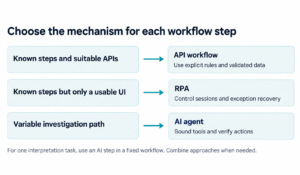 RPA is usually the better fit for stable, repeatable tasks with predefined steps, especially when automation must interact with desktop or web interfaces. AI agents are better suited to tasks requiring interpretation, contextual decisions, or variable action sequences. APIs, rules, and hybrid architectures often remain the better choice for other workflow steps.
Table of Contents
AI Agents vs RPA
RPA follows a defined execution path, while an AI agent can use a model to decide which action should come next.
That difference matters because enterprise automation problems do not all fail for the same reason. Some processes struggle because people must repeatedly click through an old application. Others struggle because someone must first understand an email, document, customer request, or incomplete set of evidence.
Treating both as the same automation problem creates unnecessary complexity.
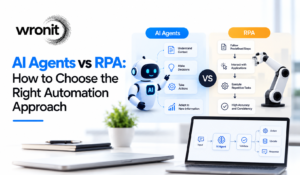 RPA is relevant when businesses need structured process automation across desktop and web applications, while AI-driven automation covers cases where interpretation, language, and model-based capabilities are required.
What is the difference between AI agents and RPA?
The core difference is who determines the execution path and when that decision is made.
An AI agent uses a model to help select actions as it works toward a goal. An RPA workflow typically executes predefined interactions with applications, although modern automation products can combine RPA with AI capabilities.
There is also a third option: a conventional API-based workflow. If two systems expose suitable APIs and the logic is stable, a scheduled job or event-driven integration may be enough.
Anthropic distinguishes predefined workflows from agents whose models direct the process dynamically. That is a useful architectural distinction, even though product marketing uses the terms differently. Anthropic: Building effective agents
Approach
|
Best starting point
|
What requires attention
|
| API-based workflow |
Known steps, structured inputs, suitable APIs |
Authentication, data mapping, retries and business rules |
| RPA |
Known procedure in a desktop or web application |
Interface changes, session state and exception recovery |
| AI step in a fixed workflow |
Interpretation is needed at one defined point |
Output validation and handling uncertain inputs |
| AI agent |
The next useful step depends on intermediate findings |
Tool scope, stopping conditions and action verification |
| Hybrid |
Different parts need different mechanisms |
Clear handoffs and one accountable process owner |
This table is a selection aid, not a claim that one product category has exclusive capabilities. Microsoft’s Power Automate documentation describes cloud and desktop flows that can be used independently or together. Microsoft: Flow types
Start by separating interpretation from execution
Consider a hypothetical distributor receiving supplier emails about invoice discrepancies. Some messages contain an invoice number and a simple status request. Others include a revised document, missing delivery evidence or an unclear account reference.
The process has several distinct jobs:
- Interpret the message and identify the request.
- Match the supplier and invoice to authoritative records.
- Retrieve permitted purchase-order and receipt information.
- Apply the company’s exception rules.
- Prepare a proposed response or review task.
- Record an approved result in the business system.
AI might help with the first job and with selecting additional evidence when the request is ambiguous. Deterministic checks should still validate identifiers, required fields and allowed actions. An API or an RPA flow can perform the final interaction, depending on the system available.
This design does not require an agent to approve payments or alter bank details. Those are separate authorities that should not be included merely because the system can understand invoice emails.
When is RPA the stronger choice?
RPA is a practical candidate when the application interface is the available integration surface and the procedure is sufficiently stable.
For example, a validated daily file may need to be entered into a legacy portal. If the fields and steps are known, adding a model to decide each click may introduce cost and variability without improving the outcome.
Microsoft describes desktop flows as a way to automate rule-based tasks across desktop and web applications. Its architecture also makes machine and session requirements relevant to deployment planning. Microsoft: Desktop flows
Before buying an RPA implementation, ask the supplier to demonstrate recovery from a changed selector, expired session, unexpected dialog, and partially completed submission. A successful happy-path recording is only part of the evidence.
Where supported, retain direct APIs for system operations and reserve UI automation for the gap that requires it. This is a design recommendation: the final choice depends on API availability, permissions, licensing and operational constraints.
When does an AI agent justify the added complexity?
An agent is more compelling when the information required cannot be determined in advance for every case.
A service specialist investigating a delayed order might need to inspect the order record, consult shipment events, check a customer message, and decide whether another lookup is necessary. The investigation path varies with the evidence.
Before granting that flexibility, define a bounded goal: produce a supported explanation and proposed next action. Specify which tools are available, which records may be accessed, and when the process must stop or escalate.
Compare the agent with a simpler baseline on the same cases. Keep the additional autonomy only if it improves the required outcome enough to justify its operating cost and failure handling. Do not infer value from the number of tools or agents in a diagram.
When should you combine agents and RPA?
A hybrid can be useful when the request needs interpretation, but the final system only exposes a UI.
For instance, the AI component could classify an incoming request and prepare a structured draft. A rules layer validates that draft. An authorized employee approves a defined change. A desktop flow enters the approved fields and returns evidence of the outcome.
Microsoft supports invoking desktop flows from cloud flows and passing values between them. The exact licensing, machine setup and cancellation behavior must be checked for the chosen configuration. Microsoft: Trigger desktop flows from cloud flows
The important boundary is that execution receives a validated instruction. Free-form generated text should not become an unrestricted command to a business application.
Four questions that make the choice clearer
1. Can the decision be expressed as a stable rule?
If yes, begin with that rule. If a model proposes a classification, validate it against allowed categories and route ambiguous cases for review. The model’s stated confidence is not a calibrated probability unless you have established that through evaluation.
2. What does a wrong action cost?
A draft internal summary and a customer-account change need different controls. Define authority by operation, record scope and business consequence. OWASP identifies excessive functionality, permissions and autonomy as distinct sources of agent risk. OWASP: Excessive agency
3. Can success be verified outside the model?
Use a system record, saved transaction reference or validated output. “The agent says it finished” is insufficient for a workflow that changes state.
4. What happens when the workflow is interrupted?
Test a timeout after a write, a duplicate message, and a restart halfway through the task. Decide how the operator identifies completed work and safely resumes the remainder.
What should US and UAE buyers put in the evaluation brief?
Use real workflow requirements rather than a regional keyword in the specification. Identify the relevant business entities, language combinations, time zones, and operational teams.
For an English-and-Arabic process, test account identifiers, bilingual messages and ambiguous terminology. For a US service desk supporting several time zones, test what happens outside the staffed escalation window. These are proposed acceptance cases, not assumptions about every company in either market.
Ask each supplier to demonstrate the same cases:
Test
|
Evidence to request
|
| Ordinary request |
Correct output and recorded completion |
| Ambiguous request |
Appropriate clarification or escalation |
| Missing permission |
No unauthorized retrieval or action |
| Duplicate input |
No unintended duplicate business operation |
| Partial system failure |
Visible status and documented recovery |
| Human intervention |
Clear ownership and resumable handoff |
Wronit’s RPA services and Generative AI services provide relevant starting points for discussing the two sides of a hybrid requirement.
FAQs
Will AI agents replace RPA?
They can change how some workflows are designed, but the categories address different needs. An agent may interpret a request while RPA interacts with a legacy application. Evaluate the process step by step before replacing an existing automation that already works reliably.
Is RPA always cheaper than an AI agent?
No. RPA can involve machine, licence and UI-maintenance costs. Agents can involve inference, evaluation and supervision costs. Compare total operating cost and accepted task completion for the same scope, including exceptions, rather than assuming one category is always less expensive.
Does using an LLM make a workflow an autonomous agent?
No. A fixed workflow can use an LLM for extraction or classification while software controls every subsequent step. The useful distinction is how much the model decides during execution, not whether a model appears anywhere in the workflow.
Choose the mechanism after mapping the process
Document one workflow, identify where judgment is required, and list the systems it must touch. Discuss that process with Wronit to define a scoped automation requirement and the evidence a pilot should produce.
#AI Agents#AI Agents vs RPA#RPA
ABOUT THE AUTHOR
AUTHOR
Maneesh Jha is an enterprise technology professional with 13+ years of experience spanning AI, Machine Learning, Data Engineering, Cloud, Automation, and Software Product Development. He helps businesses and startups navigate complex technology challenges, build scalable solutions, and turn emerging technologies into meaningful business outcomes.