Hybrid Search for RAG: How to Improve Enterprise Retrieval Accuracy
By Maneesh Jha
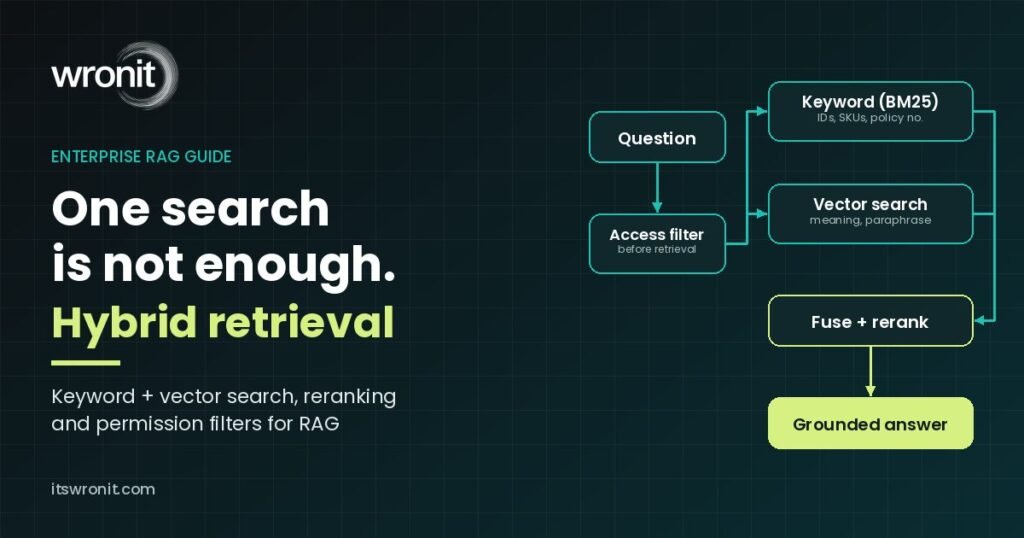
Hybrid search for RAG combines keyword search and vector search to retrieve information that matches both the exact terms and the meaning of a user’s question. For enterprise AI systems, this approach can reduce retrieval gaps involving policy numbers, technical identifiers, internal terminology, and natural-language questions.
Consider an employee asking an internal AI assistant: “What does policy HR-214 say about contractor laptops?” The assistant returns a general device policy, even though the company’s knowledge base contains the correct HR-214 document.
The problem may not be the language model. The document may have been indexed correctly but missed during retrieval. If the model never receives the right information, even a capable LLM cannot reliably answer from it.
This is why retrieval architecture deserves as much attention as model selection when moving a retrieval-augmented generation (RAG) application from prototype to production.
Why does vector-only retrieval struggle with enterprise questions?
Vector search retrieves content based on semantic similarity. It converts queries and document chunks into numerical embeddings, then identifies passages whose representations are close to the query.
This works well when employees describe an idea differently from the way it appears in a document. However, enterprise knowledge contains many details that depend on exact matching.
Identifiers and reference codes: Policy IDs, invoice numbers, product SKUs, ticket references and contract clauses need precise retrieval. A search for HR-214 should not return HR-241 simply because their surrounding descriptions are similar.
Internal terminology: Companies use department-specific acronyms, project names and technical abbreviations. General embedding models may not understand these terms in the same way employees do.
Document versions: An old policy and its current replacement may have almost identical wording. Semantic similarity alone cannot reliably establish which document is active.
Short queries: Searches such as “SOC 2 report”, “PTO carryover” or “Acme MSA” provide limited context. Exact keyword matching can be particularly valuable for these requests.
Vector search remains useful. The limitation appears when it is expected to handle semantic meaning, exact identifiers, document status and business rules through one retrieval method.
What is hybrid search for RAG?
Hybrid search combines lexical retrieval and semantic retrieval to produce a more complete candidate list for the language model.
The two retrieval methods solve different problems:
Retrieval method
How it works
Best suited to
Keyword search (BM25)
Matches and ranks documents using terms, their frequency and their distribution across the indexed content
Policy IDs, names, codes, exact phrases and technical references
Vector search
Compares embeddings to identify semantically similar content
Paraphrased questions, synonyms and natural-language queries
Hybrid search
Combines results from both retrieval methods
Enterprise questions that contain exact terms as well as broader intent
BM25 is a lexical ranking method that considers factors such as term frequency, inverse document frequency and document length. Vector retrieval uses embedding similarity to find related content even when the wording differs.
A hybrid system runs both methods and combines their results. This gives the retrieval layer two ways to find relevant information before the LLM generates its response.
How does a hybrid RAG retrieval pipeline work?
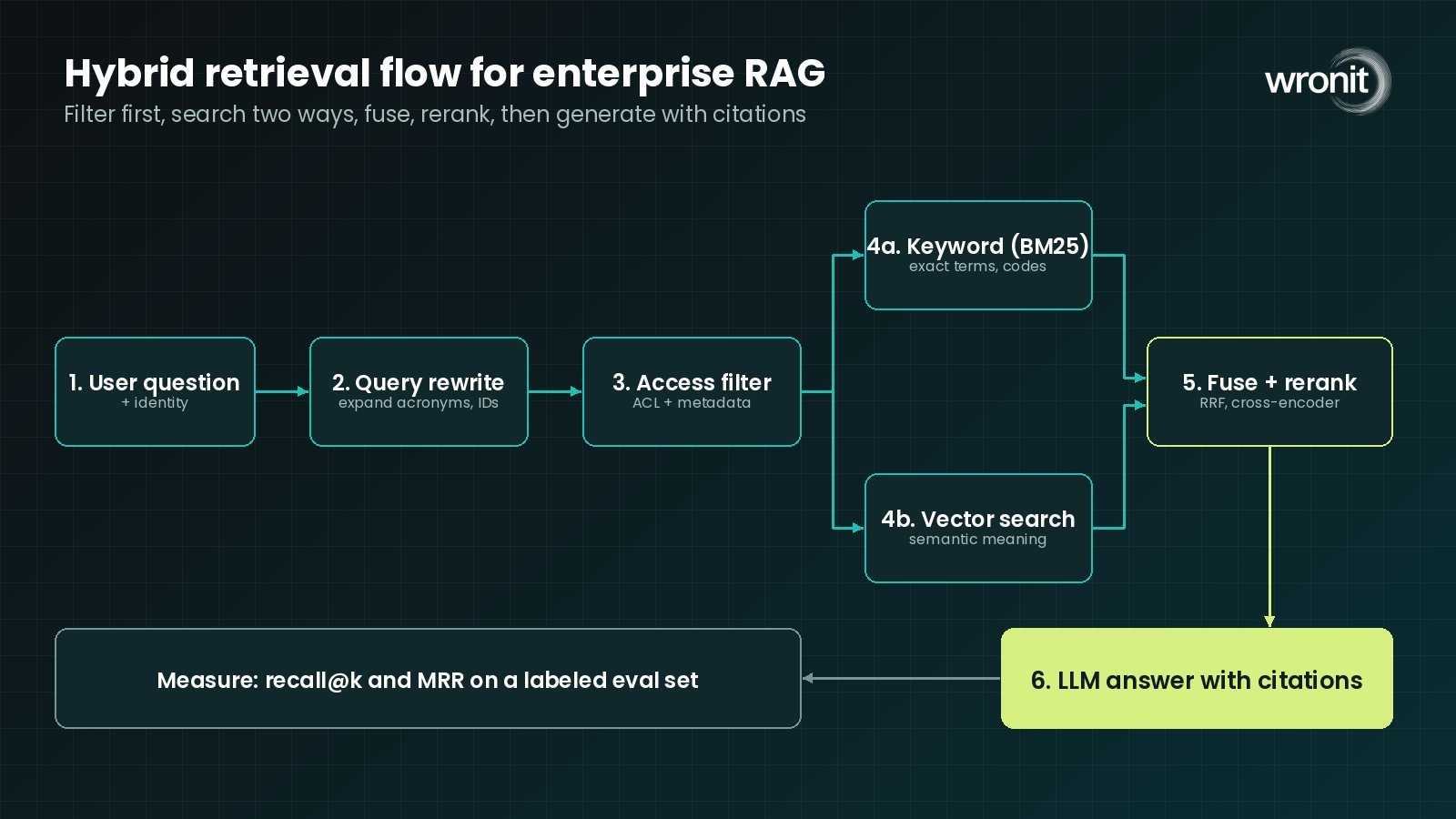
A production-oriented hybrid retrieval pipeline typically includes query processing, permission-aware retrieval, result fusion, reranking and answer generation.
The stages should work together rather than operate as disconnected search features.
1. Understand and prepare the query
The system first examines the user’s question and identifies important search signals.
For example, the question “What does policy HR-214 say about contractor laptops?” contains an exact policy identifier and a subject: contractor laptop requirements.
Query processing can extract HR-214, identify relevant synonyms and preserve the original wording. A company glossary may also expand internal abbreviations where appropriate.
The original query should remain available. Rewriting can improve retrieval, but an incorrect rewrite can change the user’s intent.
2. Apply access and metadata filters
Before retrieving candidate documents, the system should identify which information the user is authorized to access.
Useful metadata may include:
User groups and document access permissions.
Document owner and department.
Current, draft, archived or superseded status.
Effective dates and revision numbers.
Business unit, region and source system.
Permission filtering should be enforced by the retrieval system, not left to the language model to interpret after receiving the results.
Where the search platform supports it, apply the same access and business filters to both keyword and vector retrieval. If the architecture uses separate systems, enforce equivalent controls in each retrieval path and validate the results before they enter the model context.
3. Run keyword and vector retrieval in parallel
The system sends the prepared query to both search methods.
For the HR-214 example, BM25 can identify the exact policy reference. Vector search can find passages discussing contractor devices, laptop requirements and related security procedures.
Each method produces a ranked list of candidate passages. The next task is to combine them without assuming their raw relevance scores are directly comparable.
4. Combine results using reciprocal rank fusion
Reciprocal rank fusion (RRF) combines multiple ranked result lists using each document’s position rather than its original relevance score.
This is useful because BM25 scores and vector similarity scores are calculated differently. RRF avoids directly adding values that may use different scales.
A simplified RRF formula is:
RRF score = Σ 1 / (k + rank)
Here, rank is the document’s position in a result list, while k is a smoothing constant. A document appearing near the top of multiple lists receives a stronger combined position.
Elastic and OpenSearch both document RRF as a method for combining results from different retrieval strategies. https://www.elastic.co/docs/reference/elasticsearch/rest-apis/reciprocal-rank-fusion and https://docs.opensearch.org/latest/vector-search/ai-search/hybrid-search/rrf/
RRF is a practical baseline, not a guarantee of relevance. Teams should still test candidate depth, weighting and ranking behaviour against their own queries.
5. Rerank the strongest candidates
Fusion improves the combined candidate list, but the first result may not always be the most useful passage.
A reranker evaluates each candidate in relation to the original question and reorders the results. Cross-encoder models are one option because they assess the query and passage together rather than relying only on independently generated embeddings.
A typical architecture retrieves a wider candidate set, reranks it and sends a smaller selection to the LLM.
The number of candidates depends on the dataset, latency budget and model. Rather than automatically retrieving 50 or 100 passages, test several candidate sizes and retain the configuration that provides the best retrieval quality within acceptable response time.
Elastic describes this as a multi-stage retrieval process: faster retrieval methods find candidates, while more computationally intensive ranking methods refine their order. https://www.elastic.co/docs/solutions/search/ranking
Why permissions and document freshness matter as much as relevance
A hybrid search system can retrieve more relevant documents and still create serious enterprise risks if it ignores access restrictions or outdated information.
Imagine an HR assistant returning a confidential employee record because it matches the user’s question. The retrieval result may be semantically correct, but the response is still inappropriate because the user lacks permission to view it.
A reliable architecture should:
Carry document-level permissions into the indexed chunks.
Resolve user entitlements through the organisation’s identity system.
Apply authorization controls before content reaches the LLM.
Track document versions, owners and effective dates.
Exclude superseded or archived material unless the query specifically requires historical records.
Log retrieved document IDs and versions for investigation.
The ingestion pipeline matters here. If a document changes but its old chunks remain active, retrieval may return outdated information regardless of how sophisticated the ranking model becomes.
This is why RAG quality is also a data engineering and governance challenge. Document parsing, metadata extraction, version management and access-control synchronization need to be designed alongside retrieval.
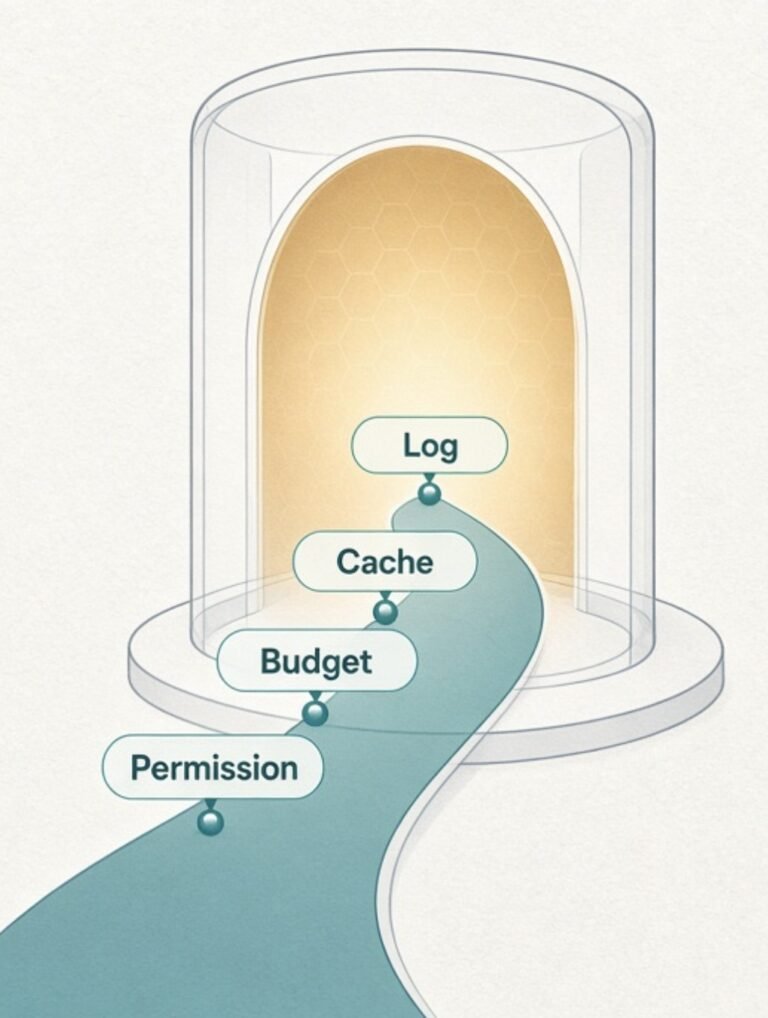
For a broader security architecture, see our guide to the secure enterprise RAG gate.
How should enterprises measure hybrid retrieval quality?
A fluent answer does not prove that retrieval worked. A language model may produce a convincing response from incomplete or incorrect context.
Measure retrieval independently before evaluating the final generated answer.
Start with a labelled evaluation set containing real employee questions and the document passages that should answer them. Include exact identifiers, acronyms, short searches, outdated versions, multi-part questions and requests that should be blocked by permissions.
Then compare vector-only, BM25-only and hybrid configurations using the same test set.
Metric
What it measures
Why it matters
Recall@k
Whether relevant passages appear within the top k results
Shows if the system retrieves the necessary information
Precision@k
How many of the top k results are relevant
Measures noise in the retrieved context
MRR
How highly the first relevant result appears
Helps evaluate ranking quality
nDCG@k
Ranking quality while accounting for graded relevance
Useful when some passages are more useful than others
Permission leakage
Restricted content returned to an unauthorized user
Security validation; the target is zero
p95 latency
Response time below which 95% of requests complete
Do not rely on one metric. High recall with poor precision can flood the prompt with irrelevant passages. Strong ranking with low recall may still miss the only document that answers the question.
Run evaluations again when changing the embedding model, chunk size, query rewriting, metadata filters, fusion configuration or reranker.
A practical implementation checklist for enterprise RAG
Before deploying hybrid retrieval across an organisation, review these implementation areas:
Index document chunks for both lexical and vector retrieval.
Preserve identifiers, headings, source references and important metadata during ingestion.
Attach document ownership, access permissions, status and version information to indexed content.
Apply equivalent authorization and metadata filters across retrieval paths.
Preserve the original query when adding rewriting or query expansion.
Use RRF as an initial fusion method, then evaluate alternatives where appropriate.
Test reranking against a representative set of business questions.
Build an evaluation dataset with exact-match, semantic, version and access-control cases.
Monitor recall, precision, ranking quality, permission leakage and p95 latency.
Log retrieval decisions and document versions so incorrect answers can be traced to their source.
The checklist should be treated as an engineering baseline. The right architecture will depend on the data sources, search platform, access model, query volume and reliability requirements.
Frequently asked questions
What is hybrid search in RAG?
Hybrid search in RAG combines keyword-based retrieval, such as BM25, with vector-based semantic retrieval. The results are merged into a unified ranking so an AI application can find documents through exact terms and contextual meaning.
Is hybrid search better than vector search for enterprise RAG?
Hybrid search can perform better when enterprise questions include identifiers, product codes, acronyms or exact policy references alongside natural-language intent. However, the improvement depends on the quality of indexing, metadata, query processing and ranking.
What is the difference between RRF and reranking?
RRF combines ranked lists from different retrieval methods using document positions. Reranking is a separate step that evaluates candidate passages against the query and changes their order based on relevance.
Does hybrid search solve hallucinations in RAG?
No. Hybrid retrieval can improve the chances of finding relevant source material, but it cannot guarantee a correct answer. Source quality, access controls, context selection, model behaviour and answer validation still matter.
How do you evaluate a hybrid RAG system?
Use a labelled set of real questions and expected source passages. Compare retrieval configurations using recall@k, precision@k, MRR and nDCG, while monitoring permission leakage and p95 latency.
When should a business implement hybrid retrieval?
Consider it when a RAG application regularly misses exact identifiers, internal terminology, document references or semantically related content. Test the current retrieval system first, then introduce hybrid search where evaluation shows a measurable gap.
Build retrieval around the information your business actually uses
A production RAG system needs more than an embedding model and a language model. It needs a retrieval layer that understands exact references, semantic meaning, document versions and user permissions.
Hybrid search provides a practical foundation by combining keyword and vector retrieval. Reranking, metadata controls and repeatable evaluation make that foundation more dependable.
If your enterprise assistant produces plausible answers but repeatedly misses the right documents, the next improvement may belong in the retrieval architecture rather than the LLM itself.
Explore Wronit’s Generative AI services or data engineering capabilities to discuss the data and retrieval foundations required for an enterprise RAG application.