Snowflake and Databricks are no longer competing only as a cloud data warehouse and a lakehouse platform. In 2026, both are expanding deeper into enterprise AI, governance, hybrid data access, and agentic workloads, making the platform decision more strategic for US businesses. Snowflake announced a $6 billion expanded collaboration with AWS in May 2026 to accelerate enterprise agentic AI adoption, while its latest platform updates are focused on interoperable, governed data and AI across cloud and open systems.
That shift makes a simple feature comparison increasingly unreliable. The important question is not whether Snowflake or Databricks has more AI, analytics, or engineering capabilities on paper, but which platform can deliver your real workloads with the right combination of performance, governance, reliability, total operating cost, and engineering effort.
A platform can look impressive in a dashboard demo or notebook proof of concept and still become expensive in production. Teams still need to ingest changing data, recover failed jobs, control permissions, maintain trusted metrics, manage AI access, support users, and explain costs after the demonstration is over.
 For businesses operating across the USA and UAE, the evaluation may also need to test regional data availability, cross-border processing, workload isolation, business-unit access, operating hours, and AI governance. These should be treated as measurable acceptance requirements rather than assumptions attached to either platform.
This article compares Snowflake vs Databricks for data engineering, business intelligence, AI, governance, cost, and enterprise operations in 2026, and shows how to evaluate both platforms using the workloads your organization will actually run.
For businesses operating across the USA and UAE, the evaluation may also need to test regional data availability, cross-border processing, workload isolation, business-unit access, operating hours, and AI governance. These should be treated as measurable acceptance requirements rather than assumptions attached to either platform.
This article compares Snowflake vs Databricks for data engineering, business intelligence, AI, governance, cost, and enterprise operations in 2026, and shows how to evaluate both platforms using the workloads your organization will actually run.
What Is the Difference Between Snowflake and Databricks?
The traditional comparison—Snowflake for BI and Databricks for data science—is increasingly incomplete.
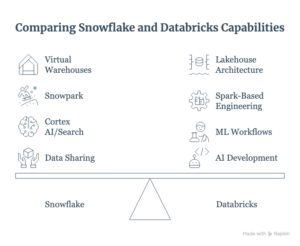
Snowflake provides virtual warehouses that supply compute resources for queries and other workloads. It also supports programmatic data processing through Snowpark and AI-oriented capabilities such as Cortex Search, which combines keyword and vector search for applications including retrieval-augmented generation.
Databricks provides SQL warehouses for analytics and BI workloads alongside data engineering, machine learning, model development and AI workflows.
This means both platforms can now participate in broader enterprise data and AI architectures.
However, overlapping capabilities do not make them interchangeable.
The result can change significantly depending on:
- existing cloud architecture
- data volume
- workload concurrency
- transformation requirements
- development skills
- BI tools
- machine learning requirements
- governance model
- data location
- commercial agreement
- operating team experience
The comparison should therefore use the configuration your organization would realistically purchase, operate and support.
Snowflake vs Databricks: Where Their Capabilities Overlap
Which Workloads Should You Test Before Choosing?
A useful platform evaluation should contain a small portfolio of workloads that represents both normal operations and the conditions that make your existing environment difficult to manage.
Each workload should have:
- a business owner
- a trusted expected result
- a measurable acceptance criterion
- known data inputs
- expected user volume
- performance expectations
- recovery requirements
A practical evaluation could include the following.
Workload
|
What to Demonstrate
|
Evidence to Retain
|
| Executive reporting |
Correct measures during normal and peak demand |
Reconciled results and response-time distribution |
| Data transformation |
Incremental loads, schema changes and failed-job recovery |
Run history, recovery time and operator effort |
| AI document retrieval |
Relevant responses from current, authorized documents |
Evaluation questions, retrieved sources and permission tests |
| Predictive analytics |
Repeatable preparation, training and deployment |
Reproduction steps and model handover requirements |
| Cross-team data sharing |
Appropriate ownership and access |
Permission changes and audit evidence |
The important point is fairness.
Do not carefully tune one platform while leaving the other on default settings. Record the configuration and engineering effort required for both.
A benchmark is more useful when another engineer can reproduce the result without relying on the person who created the original demonstration.
How Should Snowflake and Databricks Costs Be Compared?
Cost comparison is one of the easiest areas to oversimplify.
A lower platform invoice does not automatically mean a lower total operating cost.
Before requesting estimates, establish the same workload envelope for both platforms.
Document:
- data volume
- daily data growth
- query frequency
- concurrent users
- processing schedule
- freshness requirement
- AI usage
- retention period
- operating hours
Then include all relevant costs.
A realistic comparison may contain:
Platform costs
- compute
- storage
- ingestion
- transformation
- query processing
- AI-related usage
Operating costs
- monitoring
- engineering support
- administration
- governance
- incident recovery
Transition costs
- migration
- dual running
- validation
- employee training
- application changes
Separate introductory credits or temporary discounts from the ongoing commercial model.
A Simple Cost Example
Consider two hypothetical configurations.
Platform A
Platform usage: $12,000/month
Allocated operating effort: $3,000/month
Total: $15,000/month
Platform B
Platform usage: $10,000/month
Allocated operating effort: $6,000/month
Total: $16,000/month
Platform B has the lower technology bill.
But under these assumptions, it has the higher total operating cost.
These figures are illustrative only and should not be interpreted as Snowflake or Databricks pricing.

Run Cost Sensitivity Tests Before Procurement
One monthly estimate is not enough.
Test what happens when operating conditions change.
For example:
- What happens if data volume doubles?
- What happens during month-end reporting?
- What happens if 500 users query dashboards simultaneously?
- What happens when AI retrieval traffic increases?
- What happens if a nightly transformation must finish before US business hours?
- What happens when an engineering job repeatedly fails?
The goal isn’t simply to estimate today’s spend.
It is to understand how cost behaves when the workload changes.
| Scenario |
Data Volume |
Users |
Concurrency |
Snowflake Estimated Cost |
Databricks Estimated Cost |
Operational Impact |
| Baseline |
10 TB |
200 |
30 |
— |
— |
Normal |
| Data doubles |
20 TB |
200 |
30 |
— |
— |
Storage + compute |
| Month end |
10 TB |
500 |
150 |
— |
— |
Peak concurrency |
| AI growth |
10 TB |
200 |
30 |
— |
— |
Higher AI workload |
Use actual commercial estimates when the organization performs its evaluation.
How Should Governance Be Compared?
Demonstrate governance using your real organizational model.
A finance analyst, sales manager, data engineer, and external partner should not automatically receive the same access.
Snowflake provides role-based access controls, while Databricks provides centralized governance through Unity Catalog, including permissions, lineage, and auditing capabilities.
The existence of those features does not prove that a particular deployment is governed correctly.
The evaluation should test scenarios such as:
- employee changes department
- sensitive field is introduced
- external contractor loses access
- new business unit is added
- table ownership changes
- exported data moves outside the platform
- AI application retrieves restricted information
What Should Organizations Check?
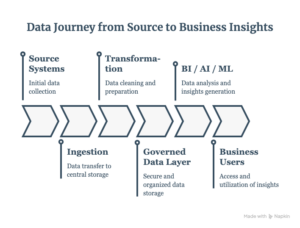
For cross-border operations, geography should become an explicit technical requirement.
Document separately:
- location of source systems
- storage location
- compute location
- backups
- disaster-recovery environment
- external AI services
- data replication
- exports
- third-party integrations
Do not assume that selecting a regional cloud deployment explains the complete data path.
If USA and UAE business units require separate access models, test that separation directly.
Organizations should also consider operational realities such as:
- different working hours
- support coverage
- currencies
- local data sources
- language requirements
- regional business processes
The architecture should reflect the business requirement rather than relying only on the cloud region selected during setup.
Can Snowflake and Databricks Both Support BI and AI?
Yes, but supporting both workloads does not mean they should be evaluated using the same success criteria.
A BI workload requires:
- reconciled metrics
- reliable queries
- predictable performance
- appropriate concurrency
An AI retrieval workload requires:
- relevant context
- current information
- permission-aware retrieval
- evaluation of generated results
A predictive analytics workflow may require:
- reproducible feature preparation
- model tracking
- controlled deployment
- monitoring
- handover documentation
A unified platform can reduce duplicated infrastructure, but it does not automatically create a unified operating model.
The evaluation should establish whether shared data preparation actually removes duplicated work and whether experimental workloads affect reporting performance or cost.
Should You Consolidate If You Already Use Both?
Not necessarily.
Some organizations may have a legitimate reason to operate both Snowflake and Databricks.
For example, one platform may already support a mature reporting environment while another supports specialized engineering or AI workloads.
However, running both also introduces additional responsibilities:
- duplicated datasets
- synchronization
- cross-platform access
- lineage
- governance
- cost management
- operating skills
Before consolidating, define the actual problem that consolidation is supposed to solve.
Migration should not become the objective simply because architectural simplification sounds attractive.
What Should a Snowflake vs Databricks Scorecard Include?
The scorecard should begin with mandatory conditions.
For example:
If a platform cannot meet a required security, deployment or access condition, strong performance in an optional feature should not compensate for that failure.
Once mandatory requirements are established, evaluate areas such as:
Evaluation Area
|
Suggested Questions
|
| Workload correctness |
Did the platform produce the expected result? |
| Performance |
Did it meet the agreed response or completion target? |
| Total cost |
What is the complete operating cost? |
| Recovery |
How quickly can failed workloads be restored? |
| Governance |
Can access, lineage and audit requirements be demonstrated? |
| Maintainability |
How difficult is a routine production change? |
| Skills |
Can the current team operate it effectively? |
| AI readiness |
Can the required AI workloads be governed and evaluated? |
Agree the scorecard weights before the vendor demonstration.
Otherwise, teams can unintentionally change the importance of criteria after seeing which platform performs better.
Criteria
|
Weight
|
Mandatory?
|
Snowflake Evidence
|
Snowflake Score
|
Databricks Evidence
|
Databricks Score
|
| Reporting performance |
15% |
Yes |
— |
— |
— |
— |
| Data engineering |
15% |
Yes |
— |
— |
— |
— |
| Governance |
15% |
Yes |
— |
— |
— |
— |
| AI workloads |
15% |
No |
— |
— |
— |
— |
| Total cost |
20% |
Yes |
— |
— |
— |
— |
| Maintainability |
10% |
No |
— |
— |
— |
— |
| Team skills |
10% |
No |
— |
— |
— |
— |
Do not publish fake platform scores. Let buyers populate the sheet using their own test evidence.
Snowflake vs Databricks: A Practical Decision Framework
Instead of asking which platform is “better,” move through these five questions.
1. What workloads matter most?
Document the reports, transformations, AI workloads and ML workflows that create business value.
2. What conditions are mandatory?
Define governance, region, access, performance and integration requirements.
Include engineering and operational effort rather than comparing only cloud consumption.
Architecture that requires skills your organization cannot sustainably support introduces another form of cost.
5. What evidence supports the decision?
Retain benchmarks, reconciled outputs, configuration details, cost assumptions and acceptance-test results.
The final decision record should explain not only why the platform was selected, but also which tradeoffs were accepted.
FAQs
Which is cheaper: Snowflake or Databricks?
There is no universal answer.
The result depends on workload type, data volume, concurrency, configuration, AI usage, commercial agreements and operating effort.
The useful comparison is the total cost of delivering the same accepted business outcome.
Is Snowflake only for business intelligence?
No.
Snowflake also provides developer, data-processing and AI capabilities, including Snowpark and Cortex-related services.
Its suitability should be evaluated against the actual workload rather than its historical positioning.
Is Databricks only for machine learning and data science?
No.
Databricks SQL warehouses support SQL analytics and BI connectivity in addition to engineering, machine-learning and AI workflows.
Neither platform should be selected for AI based on a generic label.
Evaluate the specific use case, such as:
- RAG
- document retrieval
- predictive analytics
- feature engineering
- model development
- data preparation
- AI application integration
Then compare quality, governance, operating effort, and cost.
Should we migrate before testing an AI use case?
Not automatically.
First determine whether the existing data environment can support a bounded pilot.
Migration should have its own business case, dependencies, cost model, and acceptance criteria.
Build the Decision Around Evidence, Not Positioning
The Snowflake vs Databricks decision should not come down to which platform has the strongest presentation or the longest feature list.
The better evaluation asks whether each platform can reliably deliver your priority workloads under realistic conditions.
That means testing:
Correctness → Performance → Cost → Governance → Recovery → Maintainability → AI Readiness
For US and UAE organizations, regional and cross-border requirements should also be included directly in the evaluation rather than treated as assumptions.
The result should be a decision that your engineering, data, finance and business teams can explain—and revisit when workloads change.
For organizations planning a data-platform evaluation, Wronit’s Data Engineering Services can support ingestion, transformation, and data architecture requirements, while Data Warehousing Services can support warehouse design, analytics and modernization initiatives.
You can also contact Wronit to discuss a workload-based Snowflake and Databricks evaluation.
#Snowflake vs Databricks#Snowflake vs Databricks in 2026