
- Home
- Case Study
- Custom DataHub for the Pacific Islands Forum Secretariat
Custom DataHub for the Pacific Islands Forum Secretariat
Managing and publishing historical records with Python and React
Wronit built a custom DataHub using Python and React to help the Pacific Islands Forum Secretariat upload, clean, validate, maintain, and publish historical records.
The platform streamlines data management, improves record consistency, and keeps published information useful as the collection evolves.
The Pacific Islands Forum Secretariat supports Forum Leaders and member countries in policy decision-making. Its work draws on the region's institutional knowledge and experience. Historical records are valuable in that context because they help people understand what was recorded over time.
The engagement called for a custom platform that could handle historical records from initial upload through ongoing maintenance and publication. It also needed data preparation and visualization capabilities so the collection could be checked and presented in a useful form.
Historical data can contain inconsistent labels, incomplete fields, and values whose meaning depends on their original context. The design challenge is to make the records easier to work with while preserving what they actually say.
We developed bulk upload, cleaning, and validation as part of the DataHub. These capabilities serve different purposes: upload brings records into the application, cleaning improves consistency, and validation checks whether the data meets defined requirements.
Bulk upload for collections of records
Bulk upload allows records to be brought into the platform together. For a historical collection, this is a practical starting point for loading an existing body of information and adding further batches as they become available. The essential task is to interpret the incoming structure consistently before those records are maintained or published.
Cleaning without rewriting history
Cleaning should distinguish formatting problems from changes in meaning. Removing unintended whitespace can be a routine correction. Replacing an old organization name with its current name may alter the historical record. Rules need to preserve that distinction and leave ambiguous values for review.
A record preparation example
Illustrative inputs and handling rules below explain the workflow. They are not ForumSec records or a list of production rules.
| Incoming value | Appropriate handling | Reason |
| Title has leading and trailing spaces | Trim the extra whitespace | The title remains unchanged in meaning. |
| Year is entered as 20O1 | Flag the letter O for review | Do not silently assume the intended year. |
| Two rows share a record ID but differ in title | Identify a possible conflict | A shared ID alone does not establish which row is correct. |
| A source reference is blank | Flag it when the field is required | Validation follows the requirements of the collection. |
Validation makes issues actionable
A useful validation result identifies the record, the field, and the issue. For example, “Row 18: year contains a non-numeric character” gives a maintainer something specific to correct. After correction, the record should be checked again before it contributes to publication or a visualization.
Passing validation means a record satisfies the rules that were checked. It does not, by itself, prove that the source information is historically accurate. That distinction matters whenever the platform is used as a reference.
This logical architecture groups the delivered capabilities into React user experiences and Python processing services. The internal service boundaries and correction loop illustrate a reference design, rather than a deployment or infrastructure inventory.
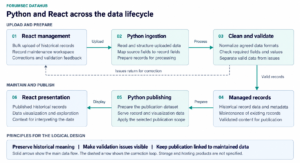
Read the top row left to right, then the lower row right to left. The managed record collection supplies publication and visualization, while issues return to the management workflow for correction.
The diagram intentionally leaves database, hosting, framework, and charting-library choices open. The product name DataHub refers to the custom application in this case study.
Record maintenance was part of the delivered solution. A historical collection is rarely complete at the first upload: another batch may arrive, a source may clarify a field, or a record may need correction. The platform therefore needed to support work on existing information as well as the addition of new records.
A correction that affects the published view
Consider an illustrative record assigned to the year 2008. A maintainer checks the source and establishes that the correct year is 2009. The change is small at field level, but a visualization that groups records by year will also change. This example shows why maintenance, validation, and presentation need to work together.
In a suitable workflow, the maintainer corrects the year, reruns the relevant checks, and confirms the revised record before publication. The published view should then reflect the corrected dataset. The record and its visualization should not tell different stories.
Separate formatting changes from factual corrections
An agreed normalization rule may handle routine formatting automatically. Factual corrections need stronger evidence. If two sources disagree on a date, the application should make the disagreement visible rather than choose a value merely because it is easier to process. Missing information should stay missing until there is a basis for filling it.
A practical review sequence
| Step | What the maintainer checks |
| Locate | Identify the record and the source of the correction. |
| Amend | Change the relevant field without altering unrelated information. |
| Validate | Check the revised record and any dependent fields. |
| Publish | Confirm the intended content is reflected in the published view. |
Illustrative maintenance sequence. It describes a reference operating pattern, not an asserted approval configuration.
Why the custom approach matters
A custom application allows record fields, validation rules, and publication views to be designed around the collection. In this project, Python and React supported the combined scope of data preparation, maintenance, and presentation. The result was an application for managing historical records throughout their useful life.
Visualization was an important part of the DataHub scope. A collection of records can answer more questions when users can see patterns in its contents, rather than inspect every entry individually. Publication makes the prepared information available through the application.
Start with a question the records can answer
A useful visualization depends on the fields and coverage of the dataset. A collection with reliable years can support a view of records over time. A collection with consistent categories can show how its contents are distributed. These examples describe possible uses of the visualization capability, not specific ForumSec dashboards.
An example of responsible interpretation
Suppose an illustrative dataset contains 120 records for one year and 80 for the next. A chart can accurately show those counts. It cannot establish that regional activity fell by one third: the difference may reflect how much material was collected, uploaded, or classified.
That distinction is especially important for historical information. The label should describe “records in the dataset,” and the view should make missing periods or incomplete coverage visible. The chart explains the collection; claims about the world need additional evidence.
Connect each view to its data
| Presentation example | Context the user needs |
| Records grouped by year | Which date is used, which years are covered, and how undated records are handled. |
| Records grouped by category | What each category means and how uncategorized entries are represented. |
| A published record | A clear title, the available source context, and the relevant historical fields. |
| A refreshed visualization | A defined publication dataset so the displayed values agree with the records. |
The role of Python and React
The custom stack connects data processing with the user experience. In the logical design, Python prepares and serves record data, while React presents the management and publication interfaces. This separation helps explain how the same collection can support maintenance work and reader-facing views without making those experiences identical.
The value lies in the connection: cleaning and validation improve the inputs that publication and visualization depend on. Presentation is most useful when users can understand both the information and its limits.
For ForumSec, we delivered a Python and React DataHub covering the upload, maintenance, and publication of historical records. Bulk upload, cleaning, validation, and visualization formed part of that solution. Together, these capabilities give the organization a dedicated application for preparing information and making it usable.
What the delivered capabilities enable
Bulk upload supports bringing collections into the platform together. Cleaning and validation provide a way to improve consistency and identify issues. Maintenance keeps existing records usable as corrections and additions arise. Publication and visualization support access to the resulting information.
The project illustrates Wronit’s approach to custom data platforms: connect the work of preparing data with the experience of managing and reading it. For historical records, this means paying attention to context and interpretation throughout the workflow.
Measure value across the workflow
A practical evaluation should measure both efficiency and data quality. The following measures are suitable for assessing a DataHub over time; they are a measurement framework, not reported project results.
| Measure | Definition |
| First pass validation rate | Records passing the initial validation checks divided by all records evaluated in that batch. |
| Issue resolution time | Elapsed time between an issue being identified and the corrected record passing validation. |
| Upload to publication time | Elapsed time from batch intake to the intended records being available in the published view. |
| Required field completeness | Populated required fields divided by all applicable required fields in the selected collection. |
| Published view consistency | Sampled displayed records or aggregates that match the publication dataset divided by all samples checked. |
Build around the information people need
For organizations planning a similar platform, begin with the records, their quality requirements, and the questions users need to answer. Wronit can bring these needs together in a custom Python and React solution covering ingestion, maintenance, publication, and visualization.
Client reference
[1] Pacific Islands Forum Secretariat Forum Secretariat and Staff
GenAI Customer Support for a Consumer Lender
A governed GenAI assistant that helps a lender's support team answer loan, repayment and policy questions from approved sources, with PII masking and human…
Read case study →
Customer Analytics and Machine Learning for an Online Retailer
Wronit built a customer analytics and machine learning platform for a multi-category online retailer in India. It joins order, web and app behaviour, and…
Read case study →