- Home
- Case Study
- GenAI Customer Support for a Consumer Lender
GenAI Customer Support for a Consumer Lender
A governed, retrieval-based support assistant for loan servicing questions, built around data protection, approved content and human handoff
This case study describes how the project team designed and delivered a generative AI support assistant for a consumer lending organization. The client is anonymized at its request, and the scope below reflects the delivery approach. Quantitative business results can be added once validated by the client or project records.
The client is a consumer lender offering personal and small-ticket loans through digital and branch channels. Its support team handles a steady flow of questions about eligibility, documentation, EMI schedules, prepayment, statements and collections. Answers depend on product policies, regulatory disclosures and customer-specific account data, and these sources change regularly.
Support quality depended heavily on individual agent experience. Policy documents, product notes and FAQs sat in several places, and agents often had to search more than one system to answer a single question. The lender wanted to use generative AI to speed this up, but lending is a regulated, high-trust domain: a wrong or unapproved answer about charges, interest or repayment carries real customer and compliance risk.
- Knowledge was spread across policy PDFs, intranet pages, product sheets and email circulars, with no single approved source.
- Customer messages routinely contain personal and financial data that must not reach an external model unprotected.
- Answers had to reflect the current approved policy version, not an older document that happened to be retrieved.
- Some questions (disputes, hardship, collections) must always go to a human, never be answered automatically.
- Leadership needed evidence the assistant was accurate and safe before any customer-facing rollout.
The requirement was a support assistant that answers only from approved content, protects customer data end to end, knows when to hand off, and can be tested and monitored like any other production system.
| Capability | Purpose |
|---|---|
| Approved knowledge base | Ingest, version and index only content signed off by product and compliance owners |
| Permission-aware retrieval | Return content according to channel and user role (agent vs. customer) |
| PII protection | Detect and mask personal and financial identifiers before any model call |
| Grounded answers with citations | Every answer links back to the source passage it used |
| Intent routing and handoff | Send sensitive intents straight to a human agent with context attached |
| Evaluation and monitoring | Test accuracy, grounding and refusals before release and track them in production |
The project team built the assistant in two stages: first as an agent-assist tool inside the support console, where a human reviews every suggested answer, and then as a customer-facing chat for a limited set of low-risk intents once evaluation results met the agreed bar.
Solution Workflow
01 Knowledge inventory and ownership
Mapped every source used by support, removed duplicates and outdated versions, and assigned an owner to each content area. Only approved, versioned documents moved into the knowledge pipeline.
02 Document processing and indexing
Parsed PDFs, web pages and product sheets into structured sections, chunked them by meaning rather than fixed length, and indexed them with metadata for product, version, effective date and audience.
03 PII masking layer
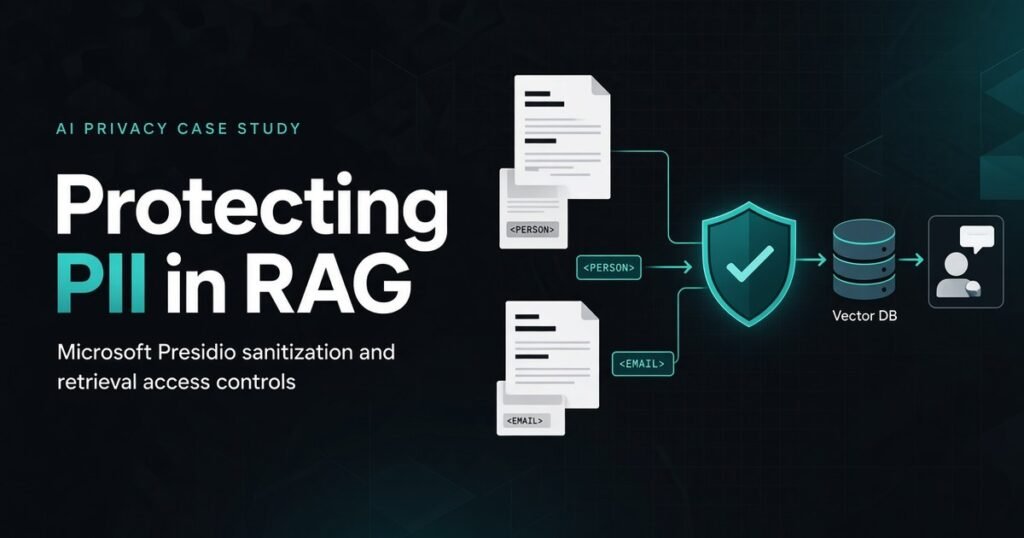
Placed a detection and masking step in front of the model so names, account numbers, phone numbers, ID numbers and similar fields are replaced with placeholders before a prompt leaves the client's environment, and restored only in the agent view where permitted.
04 Retrieval, grounding and citations
Configured retrieval to filter by audience and effective date, then generate answers only from the retrieved passages. Each response shows its sources, and the assistant declines when no approved source supports an answer.
05 Intent routing and human handoff
Classified incoming messages by intent. Disputes, hardship, complaints and collections are routed to human agents with a conversation summary, and are never answered automatically.
06 Evaluation gates and go-live
Built a test set of real (masked) support questions with expected answers, and scored the assistant on correctness, grounding, refusal behaviour and PII leakage before each release. Production conversations are sampled for ongoing review.
Illustrative example of the routing approach, not client data.
| Intent group | Example question | Assistant behaviour |
|---|---|---|
| Product information | "What documents do I need for a personal loan?" | Answer from approved policy with citation |
| Repayment schedule | "When is my next EMI due?" | Answer using account data in agent view only |
| Charges and fees | "Is there a prepayment charge?" | Answer from current fee schedule with effective date |
| Disputes and complaints | "I was charged twice this month" | Hand off to human agent with summary |
| Hardship and collections | "I can't pay this month" | Hand off to trained agent; no automated answer |
Illustrative structure of the release checklist; thresholds are set with the client and are not results.
| Check | What it measures | Release rule |
|---|---|---|
| Answer correctness | Matches the approved expected answer | Agreed threshold met on test set |
| Grounding | Every claim traceable to a cited passage | No ungrounded answers in sampled set |
| Refusal | Declines when no approved source exists | Correct refusal on out-of-scope questions |
| PII leakage | No unmasked identifiers sent to the model | Zero tolerance |
| Handoff accuracy | Sensitive intents routed to humans | All sensitive test cases routed |
Illustrative: a representative stack for this pattern. Specific tools vary by deployment.
| Area | Technology / Output |
|---|---|
| Document processing | Docling-style parsing and semantic chunking |
| Retrieval | Vector index with metadata filters (audience, version, effective date) |
| Language model | Enterprise-hosted LLM via private endpoint |
| Data protection | Microsoft Presidio for PII detection and masking |
| Orchestration | Python service layer with intent classification and routing |
| Evaluation | Automated test set scoring and production sampling |
| Channels | Support console integration and web chat widget |
The engagement gave the lender a single approved knowledge base for support, an agent-assist tool that drafts grounded answers with sources, and a controlled path to customer-facing chat for low-risk questions. Data protection, handoff rules and evaluation gates were built into the system rather than added afterwards.
- One versioned, owner-approved knowledge source for support content.
- Grounded answers with citations in the agent console.
- PII masked before any model call.
- Sensitive intents consistently routed to human agents.
- A repeatable evaluation process for every release.
The solution lets support teams answer routine questions more consistently, keeps sensitive conversations with trained staff, and gives compliance teams visibility into what the assistant says and why. Because content, controls and tests are separated, the lender can add new products or channels without rebuilding the assistant.
Generative AI in lending works when it is treated as a governed system, not a chatbot. By starting with approved content, protecting customer data, routing sensitive cases to people and testing every release, the project team delivered a support assistant the lender could trust to scale.
Planning GenAI for a regulated support team? Talk to Wronit about a scoped pilot.