
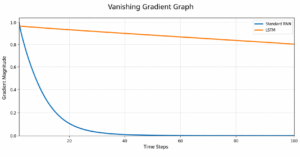
Vanishing Gradient Graph
| $390B+ US AI Market 2026 (proj.) Grand View Research / Statista | 40%+ Global AI models from USA Stanford HAI AI Index 2026 | 1990s RNN architecture origin Still in 30–40% of prod systems | ≈$2.4M Avg. cost of failed AI rebuild McKinsey Digital 2024 |
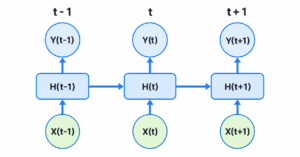
| For short, well-defined sequences with memory-constrained deployment targets, a well-tuned RNN can still outperform architecturally heavier alternatives on cost, speed, and interpretability. |
Vanishing Gradient Graph
| ✅ PROS | ⚠️ CONS / LIMITATIONS |
| Sequential data modeling by design | Vanishing gradient — poor long-range memory |
| Implicit memory via hidden state | No GPU parallelization — slow training |
| Handles variable-length inputs natively | Struggles beyond 300–500 token sequences |
| Lower parameter count for short sequences | Gradient explosion without careful tuning |
| Interpretable hidden state vector | Largely superseded in NLP by Transformers |
| Works well on edge/embedded deployments | Higher inference latency than modern SSMs |
| Suitable for simple time series tasks | Difficult to debug in deep architectures |
| The companies most stuck on RNNs are not those that chose them in 2018 — it’s those that never created an architecture review process to know when to evolve. |
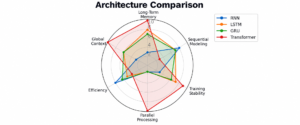
| Dimension | Standard RNN |
| Long-range memory | ❌ Poor — vanishing gradient degrades past ~20 steps |
| Training speed | ⚠️ Slow — sequential processing, no GPU parallelization |
| Short sequence accuracy | ✅ Competitive — lighter model, less overfitting risk |
| Implementation simplicity | ✅ Simple — fewer gates, fewer hyperparameters |
| Production latency | ⚠️ Moderate — depends on sequence length |
| Best current use case | IoT sensor streams, very short sequences, embedded/edge AI |
| Dimension | LSTM / GRU (Recommended Upgrade) |
| Long-range memory | ✅ Strong — gating mechanism controls gradient flow |
| Training speed | ⚠️ Still sequential — slower than Transformers |
| Short sequence accuracy | ✅ Excellent — default choice over standard RNN |
| Implementation simplicity | ⚠️ Moderate — 3–4 gates require careful tuning |
| Best use case | Time series (up to ~1,000 steps), audio, genomics, structured sequences |
| Dimension | Transformer (Modern Default for NLP/Long Sequences) |
| Long-range memory | ✅✅ Excellent — full attention over entire context window |
| Training speed | ✅✅ Fast — fully parallelizable on GPU clusters |
| Short sequence performance | ⚠️ Overkill — heavy for very short, simple sequences |
| Parameter count | ⚠️ High — requires large compute budget |
| Best use case | NLP (all tasks), document AI, multi-modal, long-context reasoning |
| ⚠️ When You Should NOT Build with a Standard RNN in 2026 |
| Any NLP task — use a fine-tuned Transformer or LSTM at minimum Sequences longer than 200 steps — vanishing gradient will degrade performance Real-time applications with sub-20ms latency requirements — sequential inference cannot meet this New production systems where LSTM or GRU are available — the upgrade cost is negligible Any use case with budget to train and maintain — LSTM/GRU provide strictly better performance for the same training cost |