Artificial intelligence does not always work with independent pieces of information. Many real-world problems involve sequences where the order of information matters.
A sentence is a sequence of words. A customer’s transactions form a sequence over time. Sensor readings arrive continuously. Stock prices, machine data, speech, and user activity can all contain patterns that depend on what happened previously.
This is where a Recurrent Neural Network (RNN) becomes useful.
An RNN is a type of neural network designed to process sequential data by using information from previous steps while processing the current input. Unlike a traditional feedforward neural network, an RNN has a form of internal memory that allows information from earlier parts of a sequence to influence later predictions.
RNNs became an important foundation for sequence modeling and helped enable applications in language processing, speech, time-series analysis, and other areas where the order of data matters. Modern architectures such as LSTM and GRU were later developed to address important limitations of basic RNNs.
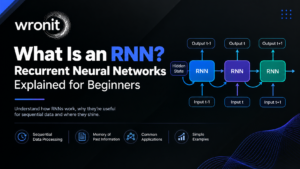
But what exactly is an RNN, and how does it work?
A Recurrent Neural Network (RNN) is a deep learning model designed to work with sequential or time-dependent data.
The defining characteristic of an RNN is its recurrent connection. Instead of treating every input independently, the network carries information from a previous step into the next step.
For example, consider the sentence:
“The company launched a new product because it wanted to increase…”
To understand what might come next, the model benefits from information it has already processed.
An RNN processes the sequence step by step, updating its internal hidden state as new information arrives.
In simplified form:
Current Input + Previous Hidden State → New Hidden State → Output
This gives the model a way to incorporate previous context when making a prediction.
That ability makes RNNs particularly relevant when sequence and timing are important to the problem.
Traditional neural networks generally assume that inputs can be processed independently.
That assumption does not work well for many real-world datasets.
Consider a simple temperature dataset:
Monday → Tuesday → Wednesday → Thursday → Friday
The temperature recorded on Thursday may be related to previous observations. A model that understands the sequence can potentially identify trends that are difficult to represent when every observation is treated as completely independent.
The same principle applies to:
RNNs were designed to capture these types of temporal relationships. Research literature continues to identify RNN-based architectures as useful for sequential data and time-dependent tasks.
The easiest way to understand an RNN is to imagine it reading a sequence one element at a time.
Suppose the inputs are:
X₁ → X₂ → X₃ → X₄
At the first step, the RNN receives X₁ and produces a hidden state.
At the second step, it receives X₂ while also using information from the previous hidden state.
The process continues:
X₁ → Hidden State₁ X₂ + Hidden State₁ → Hidden State₂ X₃ + Hidden State₂ → Hidden State₃ X₄ + Hidden State₃ → Hidden State₄
The hidden state acts as a compact representation of information carried forward through the sequence.
A simplified representation is:
hₜ = f(Wxₜ + Uhₜ₋₁ + b)
Where:
The important idea is not the equation itself. It is that the previous state influences the current state.
That recurrent mechanism is what separates an RNN from a standard feedforward network.
A basic RNN can be viewed as a repeated processing unit.
When shown as a single diagram, the recurrent connection can make the architecture look complicated. It becomes easier to understand when the network is unrolled through time.
For example:
Input 1 → RNN → Output 1 ↓ Input 2 → RNN → Output 2 ↓ Input 3 → RNN → Output 3
The same network parameters are reused across the sequence.
This parameter sharing is important because the model does not need a completely separate set of weights for every position in a sequence.
The architecture therefore provides a practical way to process sequences of different lengths while maintaining information about previous steps.
RNNs are primarily associated with sequential data, where the order of observations contains useful information.
Words in a sentence have an order.
For example:
“Wronit develops AI solutions”
Changing the order of the words changes the meaning.
RNN-based models were historically important in natural language processing because they could process text sequentially and maintain information from earlier words.
Time-series data records observations over time.
Examples include:
An RNN can learn patterns across successive observations.
Audio signals are naturally sequential. Previous parts of a signal can provide context for later parts.
RNN-based architectures have therefore been used in speech and audio-related applications.
IoT devices can continuously generate measurements such as:
An RNN can be used to identify patterns in these sequences or support prediction and classification tasks.
Businesses also generate sequential events.
For example:
Login → Product View → Add to Cart → Checkout
The order of those actions can contain useful information for analytics and prediction.
RNNs and their variants have been applied across many sequence-processing problems.
Common applications include:
An RNN can analyze previous observations to help predict future values.
For example, a business could use sequential sales data to model demand patterns.
An RNN can process words in sequence and classify the overall sentiment of a piece of text.
RNN-based models have historically been used to process sequential audio information.
RNNs can classify an entire sequence based on the information contained within it.
An RNN can learn patterns in normal sequential behavior and help identify unusual events.
Industrial equipment produces continuous streams of sensor data. RNN-based models can be used to identify temporal patterns associated with machine behavior and potential failures.
These applications share one characteristic: the relationship between data points depends partly on their position or order in the sequence.
The major difference is how information is processed.
A conventional feedforward neural network generally processes an input without maintaining a recurrent hidden state from a previous input.
An RNN, on the other hand, carries information forward through the sequence.
| Feature | Traditional Neural Network | RNN |
|---|---|---|
| Sequential processing | Limited | Yes |
| Previous-state information | No | Yes |
| Suitable for time-series | Possible with additional design | Naturally suited |
| Variable-length sequences | Possible | Yes |
| Temporal relationships | Limited | Stronger focus |
| Recurrent memory | No | Yes |
This does not mean an RNN is automatically better. The correct architecture depends on the dataset, sequence length, task, computational requirements, and desired performance.
RNNs introduced an important approach to sequence modeling, but basic RNNs also have well-known limitations.
The most important issue is their difficulty in learning long-term dependencies.
As information and gradients pass through many sequential steps, the influence of earlier information can become increasingly difficult to preserve. This is closely related to the vanishing gradient problem.
RNNs can also experience exploding gradients, which can make training unstable.
Another challenge is sequential processing. Because later steps depend on earlier steps, RNN computation is less naturally parallelizable than architectures designed for more parallel processing.
These limitations became major reasons for developing more advanced architectures such as LSTM and GRU.
This is important when evaluating whether an RNN is appropriate for a production AI system.
A model can be technically capable of processing a sequence without being the most suitable architecture for every sequence-processing problem.
LSTM, or Long Short-Term Memory, is a specialized type of recurrent neural network.
The basic RNN can struggle to preserve useful information across long sequences. LSTM was specifically designed to address this challenge through a more sophisticated memory mechanism and gating structure.
An LSTM uses gates to control the flow of information through its memory.
In simple terms, these gates help the model determine:
Because of this design, LSTMs are generally better suited than basic RNNs for problems involving longer-term dependencies.
So:
RNN = simpler recurrent architecture
LSTM = recurrent architecture with enhanced memory control
A Gated Recurrent Unit (GRU) is another recurrent architecture designed to improve the handling of information across sequences.
GRUs use gating mechanisms but have a different structure from LSTMs.
In practical model development, engineers may evaluate RNN, LSTM, and GRU architectures based on factors such as:
There is no universal architecture that is optimal for every sequence problem.
Transformers changed sequence modeling significantly by using attention mechanisms rather than relying on the same recurrent processing approach.
This makes Transformers particularly powerful for many large-scale language and sequence tasks and allows greater parallel processing during training.
However, this does not make RNNs universally obsolete.
Research comparing sequence architectures shows that RNNs and LSTMs can still be relevant when a problem has a clear temporal structure, while Transformers are particularly suited to large-scale tasks where parallel processing and complex long-range relationships are important.
For an enterprise AI project, the decision should therefore be based on the actual data and business problem, not simply on which architecture is newer.
Yes, but their role has changed.
RNNs were once central to many sequence-processing applications. Today, organizations have a much broader range of architectures to choose from, including:
Basic RNNs may still be useful when the sequence is relatively straightforward, the model needs to remain simple, or the project benefits from a lightweight recurrent architecture.
For more demanding long-context applications, an LSTM, GRU, Transformer, or another architecture may be more appropriate depending on the requirements.
Recent research continues to study RNN-family models alongside newer architectures rather than treating sequence modeling as a single-architecture problem.
An RNN may be worth evaluating when:
For example, an organization analyzing a stream of sensor readings may start by testing an RNN-based approach and then compare its performance with LSTM, GRU, or Transformer-based alternatives.
The key is benchmarking the architecture against the actual business problem.
A basic RNN deserves more scrutiny when the project requires:
In such cases, LSTM, GRU, Transformer, or hybrid architectures may be worth evaluating.
The choice should ultimately consider accuracy, latency, training cost, inference requirements, data characteristics, and maintainability rather than following architecture trends alone.
Understanding RNNs is still valuable because they explain an important stage in the evolution of deep learning.
RNNs established a practical approach for processing information where sequence matters.
LSTM and GRU addressed important limitations of basic recurrent networks.
Transformers later introduced a different approach to handling relationships within sequences and became highly influential in modern AI and natural language processing.
For businesses exploring AI, this evolution highlights an important lesson:
The newest model is not automatically the right model.
The right architecture depends on what the data looks like, what the model needs to predict, how much context matters, how quickly it must respond, and what resources are available for development and deployment.
A Recurrent Neural Network (RNN) is a deep learning architecture designed to process sequential data by carrying information from previous steps through a hidden state.
This makes RNNs useful for problems where order, timing, and previous context matter.
They have been used across time-series forecasting, speech, text processing, anomaly detection, sensor data, and other sequential applications. However, basic RNNs also have limitations, particularly when learning long-term dependencies and handling long sequences.
These limitations led to the development of architectures such as LSTM and GRU, while Transformers introduced another powerful approach to sequence modeling.
For businesses evaluating AI, the important question is therefore not simply “Are RNNs old?” but:
“Does an RNN architecture fit the data, performance requirements, and business problem we need to solve?”
Understanding that distinction is the foundation for choosing the right AI architecture.
In the next step, it is useful to look more closely at the advantages and disadvantages of RNNs, including where they still provide practical value and where another architecture may be a better fit.RNN stands for Recurrent Neural Network. It is a neural network architecture designed to process sequential data while carrying information from previous steps.
RNNs can be used for sequential tasks such as time-series analysis, sequence classification, speech processing, text processing, anomaly detection, and predictive modeling.
An RNN maintains a hidden state that is updated as it processes each element of a sequence. This hidden state carries information from earlier steps into later steps.
Basic RNNs can struggle with long-term dependencies because of problems such as vanishing and exploding gradients. Their sequential processing can also make training less parallelizable.
Yes. LSTM is a specialized type of recurrent neural network designed to improve the handling of longer-term dependencies.
Neither architecture is universally better. The appropriate choice depends on the sequence, dataset, context requirements, computational resources, and business objective.
Yes. RNN-family architectures remain relevant for certain sequential and time-series problems, although modern AI systems also have alternatives such as LSTM, GRU, and Transformer architectures.
