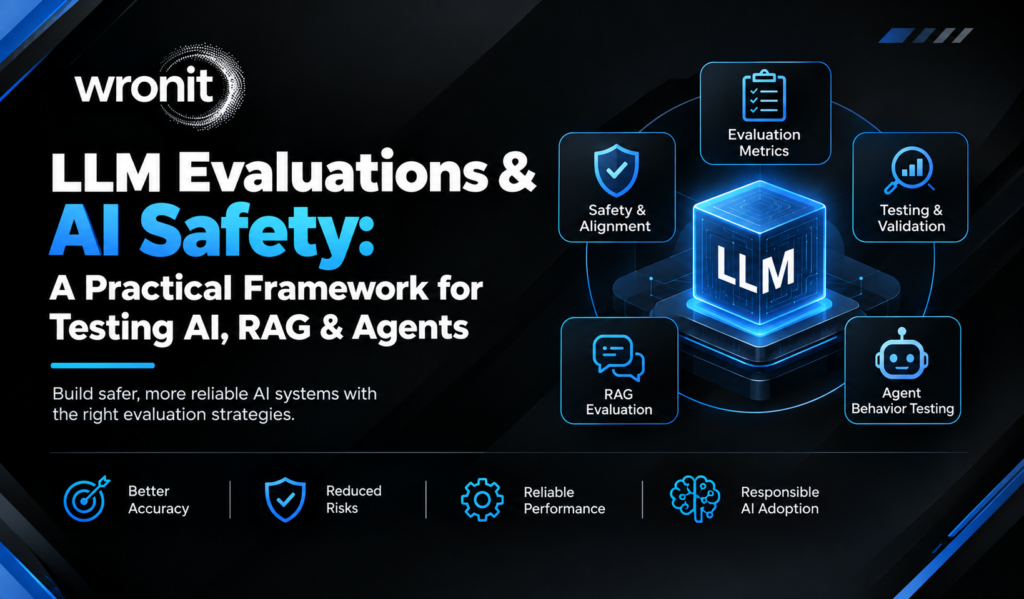
LLM Evaluations & AI Safety: A Practical Framework for Testing AI, RAG & Agents
By Maneesh Jha
LLM Evaluations and AI Safety
How to test what AI can do, what it might get wrong, and what it can cause in the real worldA practical guide for teams building reliable LLM, RAG, and agentic AI systemsHero visual: LLM evaluation and AI safety across model, application, security, and monitoring layers.
The uncomfortable truth: an AI can sound right and still be wrong, unsafe, or insecure.
Large language models (LLMs) are no longer confined to chat windows. They summarize documents, generate code, answer customer questions, search internal knowledge, route support requests, and increasingly call tools or take actions on a user’s behalf.
That changes the engineering question. Instead of asking only, “Which model is smarter?”, teams need to ask: How reliably does the system perform its intended task? When does it hallucinate? Can it be manipulated? What private information can it expose? What happens when an agent is given access to tools? How do we know a new model or prompt hasn’t quietly introduced a regression?
This is where LLM evaluations and AI safety meet. A mature evaluation program is not a single benchmark score. It is a repeatable way to measure capabilities, failure modes, security, and safety across the actual system people will use.
Why fluency is not evidence: evaluation must separate plausible language from supported, safe behavior.
What Are LLM Evaluations?
LLM evaluation is the systematic measurement of a model or AI application against predefined criteria. Depending on the use case, those criteria may include accuracy, relevance, factuality, robustness, safety, security, instruction following, tool-use reliability, latency, and cost.
The important distinction is that evaluation is not the same as casual testing. A useful evaluation has a defined task, representative test cases, explicit success criteria, a grading method, and a way to compare results over time. Stanford’s HELM work is a good example of multidimensional evaluation: it treats model quality as more than one capability score, while HELM Safety evaluates multiple risk categories and testing approaches.
Stanford HELM Safety: HELM Safety v1.0 covers six risk categories across five safety benchmarks and evaluates models for risks including violence, fraud, discrimination, sexual content, harassment, and deception—source: Stanford CRFM.
Why AI Safety Needs More Than a Benchmark
A benchmark answers a narrow question under controlled conditions. Production systems add context: your prompts, your retrieval pipeline, your users, your permissions, your internal documents, your tools, and your operational environment.
NIST’s Generative AI Profile places trustworthiness considerations across the AI lifecycle, including design, development, use, and evaluation. That lifecycle view matters because AI risk is not created only inside model weights; it can also emerge from system design and deployment choices.
NIST AI RMF Generative AI Profile: The profile is a companion resource to the AI Risk Management Framework for incorporating trustworthiness considerations into the design, development, use, and evaluation of generative AI systems. Source: NISTThe evaluation stack: test the model, the application, the agent, and the live production system.
The Four Evaluation Layers
1. Model evaluation
Measure capabilities and model behavior such as reasoning, coding, instruction following, factuality, robustness, and safety. The question is: “What can the model do, and how does it behave under pressure?”
2. Application evaluation
Test the system around the model: prompts, RAG, retrieval quality, output validation, user roles, access controls, and application logic. A safe base model does not make an insecure application safe.
3. Agent and tool evaluation
When a model can call APIs, send messages, write files, execute code, or modify records, test the actions themselves. The question becomes: “What can the complete system cause?”
4. Production evaluation
Monitor real behavior over time. Capture failures, user feedback, incidents, drift, cost, latency, and new attack patterns. Convert important production failures into regression tests.
The Major Types of LLM Evaluations
Capability evaluations
Measure whether the system can actually perform its intended task: reasoning, coding, extraction, summarization, classification, domain-specific Q&A, and tool use.
Factuality and grounding evaluations
Test whether answers are supported by source material, whether citations are correct, whether claims are fabricated, and whether the system communicates uncertainty when evidence is missing.
Safety evaluations
Test harmful or disallowed behaviors, edge cases, over-refusal, unsafe assistance, and policy adherence. HELM Safety illustrates why multiple risk categories are needed rather than a single “safe/unsafe” number.
Robustness evaluations
Probe sensitivity to typo patterns, long context, conflicting instructions, unusual formatting, multilingual inputs, and adversarial phrasing.
Security evaluations
Test prompt injection, sensitive-information exposure, unsafe output handling, excessive agency, system prompt leakage, data/model poisoning, and vector or embedding weaknesses. OWASP’s 2025 Top 10 is a useful checklist for these application-level risks.
Bias and fairness evaluations
Measure behavior across relevant languages, populations, and user contexts, with metrics chosen for the specific application rather than a universal score.
OWASP 2025 LLM risks: The current OWASP Top 10 for LLM Applications includes prompt injection, sensitive information disclosure, supply-chain vulnerabilities, data and model poisoning, improper output handling, excessive agency, system prompt leakage, vector and embedding weaknesses, misinformation, and unbounded consumption.
RAG: Where Retrieval Becomes Part of the Safety Boundary
Retrieval-Augmented Generation (RAG) creates a second evaluation problem. A final answer can be wrong because the right document was never retrieved, because the wrong document ranked first, because the model ignored relevant evidence, or because access controls allowed content that a user should never have seen.
That means RAG evaluation should be decomposed: measure retrieval quality, context quality, grounding, final answer quality, and authorization separately. This makes debugging much faster because the team can identify whether the failure originated in search, access control, or generation.
Prompt injection can travel through retrieved content when untrusted data is treated as instructions.
A practical principle is to treat retrieved content as data, not authority. Trusted instructions, authentication, and authorization should remain outside the model’s discretion wherever possible.
AI Agents: Evaluate Actions, Not Just Answers
Agentic systems make the evaluation target bigger. A chatbot may produce an answer. An agent may plan, call a tool, inspect a result, retry, select another tool, and finally take an external action.
For agents, every action boundary becomes an evaluation point.
OWASP describes excessive agency as a risk when unexpected, ambiguous, or manipulated model outputs can trigger damaging actions. The core controls are straightforward in principle: minimize functionality, minimize permissions, and minimize autonomy.
OWASP on excessive agency: The 2025 guidance identifies excessive functionality, excessive permissions, and excessive autonomy as common root causes of excessive agency.
How to Build an LLM Evaluation Program
Step 1 — Define the intended use
Document users, tasks, data sources, tools, permissions, and the consequences of failure. The risk profile of a marketing assistant is not the same as a system that can change customer records.
Step 2 — Build the evaluation dataset
Include golden cases, edge cases, adversarial cases, regression cases, and privacy-safe production-derived cases. Version-control the dataset just like code.
Step 3 — Define measurable criteria
Examples include factual accuracy, groundedness, unsafe-response rate, unauthorized disclosure rate, tool-call accuracy, task completion, latency, and cost.
Step 4 — Use multiple graders
Combine deterministic checks, structured validators, LLM-as-a-judge, and human review. Model-based graders are useful but should themselves be calibrated and checked.
Step 5 — Red team intentionally
Try prompt injection, jailbreaks, data extraction, malicious documents, permission escalation, and unsafe tool use. The goal is to discover failure modes before users do.
Step 6 — Gate changes
Run evaluation automatically when models, prompts, retrieval logic, tools, policies, or permissions change.
Step 7 — Learn from production
Turn important incidents and recurring failures into regression tests so the evaluation suite becomes more representative over time.
A strong evaluation program continuously learns from production failures.
LLM Evaluation Metrics That Actually Help
Metric
What it tells you
Accuracy
Is the answer correct?
Groundedness
Are claims supported by supplied or retrieved evidence?
Hallucination rate
How often does the system invent unsupported information?
Unsafe-response rate
How often does the system produce disallowed or harmful output under defined tests?
Attack success rate
How often does an adversarial scenario bypass controls?
Tool-call accuracy
Did the agent select the right tool and parameters?
Task completion
Did the end-to-end workflow actually finish correctly?
Latency / cost
Can the system operate within product constraints?
Why Benchmark Scores Alone Are Not Enough
Benchmark scores are useful signals, but they can be misleading when treated as production guarantees. Your application may differ from a benchmark in data distribution, task structure, system prompt, retrieval context, permissions, tool access, or adversarial pressure.
Benchmarks provide useful signal; production evaluation tests the environment in which the system can actually fail.Evaluation integrity matters too. METR publishes task-completion time horizons for frontier AI agents using diverse software tasks, and its methodology illustrates a broader move toward evaluating what agents can accomplish in realistic, multi-step environments rather than only isolated answers.
A Practical AI Safety Checklist
Do we know the highest-impact failure modes for this specific use case?
Do we test normal, edge-case, adversarial, and regression scenarios?
Can the system expose information a user should not see?
Are model outputs validated before they reach downstream systems?
Are AI tools restricted by least privilege?
Can we inspect tool calls and important intermediate actions?
Do production incidents become new evaluation cases?
Can we block deployment when critical safety or security tests fail?
The Bigger Picture: AI Safety Is an Engineering Loop
The most useful way to think about AI safety is not as a final compliance checkbox. It is an engineering loop: define the intended behavior, measure it, attack it, deploy it with controls, observe failures, and feed those failures back into the next version of the evaluation suite.
As models gain stronger reasoning and agentic capabilities, this loop becomes more important. METR’s public work on task-completion time horizons is one example of the industry’s broader effort to measure increasingly capable agents on longer and more realistic tasks.
The takeaway: You do not prove an AI system is perfect. You build evidence about where it performs well, where it fails, what safeguards work, and whether the remaining risk is acceptable for the job it is being asked to do.
How Wronit Can Help
Building reliable AI applications requires more than choosing a strong LLM. Teams need evaluation datasets, RAG architecture, security controls, observability, regression testing, and production monitoring that match the real use case.
Wronit Technocraft Pvt Ltd is a technology company delivering data, AI, software, cloud, and digital solutions to businesses across international markets. For organizations building or scaling LLM, RAG, and agentic AI applications, a structured evaluation and AI safety approach can help turn experimental capabilities into dependable production systems.
Building or scaling an AI system? Talk to the Wronit team about an evaluation strategy designed around your use case.
Frequently Asked Questions
What is an LLM evaluation?
An LLM evaluation is a structured process for measuring an AI model or application against defined criteria such as accuracy, factuality, safety, robustness, security, instruction following, or task completion.
Why are LLM evaluations important for AI safety?
They provide evidence about failure modes and whether safety controls work under normal and adversarial conditions. They also make regressions visible when the model, prompt, retrieval system, tools, or policies change.
How do you test an LLM for safety?
Use a combination of curated datasets, adversarial prompts, red-team scenarios, deterministic checks, model-based grading, and human review for high-risk or ambiguous cases.
How do you evaluate a RAG application?
Separate retrieval quality, context quality, grounding, answer quality, and authorization. This helps identify whether a failure came from search, access control, or generation.
How should AI agents be evaluated?
Evaluate the full workflow: planning, tool selection, parameters, permissions, intermediate actions, recovery behavior, task completion, and unintended actions – not only the final answer.
How often should an AI application be evaluated?
Evaluation should be part of the development lifecycle and rerun when meaningful changes are made to the model, prompt, retrieval pipeline, tools, permissions, policies, or deployment environment. Production incidents should add new regression cases.
#AI#AI Safety#LLM Evaluations#LLM Evaluations & AI Safety#RAG & Agents
ABOUT THE AUTHOR
Maneesh Jha
AUTHOR
With 11+ years of experience in enterprise technology, AI, Machine Learning, Data Engineering, Cloud, Automation, and Software Product Development, he helps businesses and startups turn complex technology challenges into scalable solutions that drive innovation and growth.