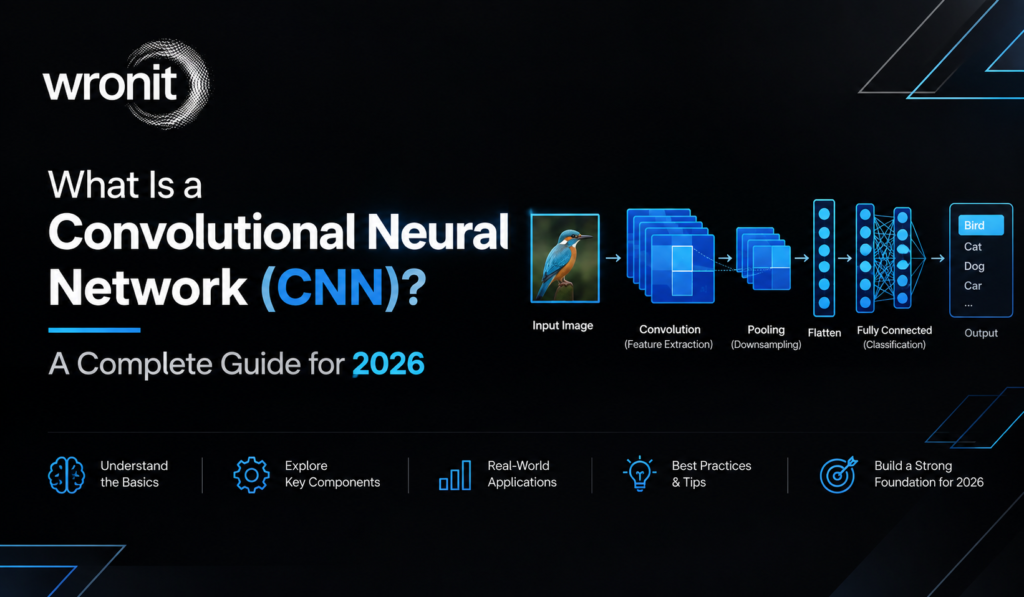
What Is a Convolutional Neural Network (CNN)? A Complete Guide for 2026
By Maneesh Jha
A convolutional neural network (CNN) is a deep learning model that processes grid-structured data — most commonly images — by scanning small local regions with learned filters, then combining what it finds into increasingly complex visual features. CNNs are the reason modern computer vision systems can detect a manufacturing defect, read an X-ray, or recognize a face without a human ever telling the model what an “edge” or a “shape” looks like — the network learns that hierarchy directly from data.
If you’ve landed here because you’re deciding whether a CNN is the right architecture for a project, trying to understand why your model isn’t performing the way a tutorial said it would, or simply trying to get a working technical grasp of the concept, this guide covers all three. It’s organized so you can jump to the section you actually need.
Table of contents
What a CNN is and why it exists
How a CNN works, layer by layer
CNN vs. ANN, RNN, and vision transformers — what’s actually different
The major CNN architectures and what each one solved
Where CNNs are used in production today
Advantages and limitations — the honest version
Common problems that stall CNN projects, and how to fix them
How to decide if a CNN is the right architecture for your use case
Frequently asked questions
1. What a CNN is and why it exists
Before CNNs became standard, computer vision relied on hand-engineered features. A developer would write explicit rules to detect edges, corners, or specific shapes, and a traditional machine learning model would classify images based on those rules. This worked, but poorly — it was brittle, labor-intensive, and fell apart the moment lighting, angle, or image quality shifted from what the rules anticipated.
A convolutional neural network removes that bottleneck by learning the features itself. Instead of a person deciding what an edge or a wheel looks like, the network is shown thousands (or millions) of labeled examples and learns, layer by layer, what patterns actually predict the correct answer.
Why “convolutional”? The term refers to the mathematical operation at the network’s core — convolution — where a small filter slides across an image and calculates a response at each position. This single operation, repeated with many different filters across many layers, is what lets a CNN go from raw pixels to “this is a car” or “this tissue sample shows abnormal cell structure.”
Why CNNs matter beyond the history lesson: They’re one of the few deep learning architectures where the underlying mathematical structure — parameter sharing and translation equivariance, explained below — directly matches the structure of the data (images) they’re applied to. That match is why CNNs remain efficient even against far larger, more general architectures.
2. How a CNN works, layer by layer
Understanding a CNN means understanding what each layer type contributes. Skipping any one of these is usually where confusion (and, later, debugging pain) starts.
Convolutional layers — the feature detectors
A convolutional layer applies a filter (also called a kernel) — a small matrix of learnable weights, commonly 3×3 or 5×5 — across the input image. At every position, the filter calculates a weighted sum, producing a single value in what’s called a feature map. Slide that filter across the whole image, and you get a full feature map highlighting everywhere that pattern appears.
A network uses many filters per layer, each learning to detect something different: one might respond to vertical edges, another to a particular color transition, another to a texture. Nobody assigns these roles manually — the network discovers them during training by adjusting filter weights to minimize prediction error.
Why this is efficient: because the same filter is reused across the entire image (parameter sharing), a convolutional layer needs vastly fewer parameters than a fully connected layer processing the same image. This is the single biggest reason CNNs can be trained on standard hardware where a naively connected network would need unrealistic amounts of memory.
Pooling layers — the compressors
After convolution, pooling layers shrink the feature maps. Max pooling keeps only the strongest value in each small region; average pooling takes the mean. Either way, the effect is the same: less data flows into the next layer, which reduces compute cost and helps the model tolerate small shifts in where a feature appears — a scratch on a product that’s two pixels to the left still gets detected.
Activation functions — the non-linearity
Every convolution is followed by an activation function, almost always ReLU (Rectified Linear Unit) in modern CNNs. ReLU passes positive values through unchanged and zeroes out negative ones. This sounds trivial, but it’s structurally necessary: without a non-linear step between layers, stacking a hundred convolutional layers would mathematically collapse into the equivalent of one linear layer, and the network would lose its ability to model complex patterns.
Fully connected / classification layers — the decision-maker
After several rounds of convolution and pooling, the network has a compact set of high-level features. Classic CNN designs flatten these into a vector and pass them through fully connected layers; most modern architectures use global average pooling into a lightweight output layer instead, which is more parameter-efficient. Either way, this is where the network turns “these are the features present” into “this image is 87% likely to be a defective part.”
Stride, padding, and receptive field — the tuning knobs
Stride is how far the filter moves between calculations. A stride of 1 checks every position; a stride of 2 skips every other one, producing a smaller, cheaper output.
Padding adds a border of (usually zero-value) pixels around the image before convolution, which prevents the feature map from shrinking too aggressively and preserves information at the edges.
Receptive field is how much of the original image influences a given neuron’s output. It grows as layers stack — early neurons “see” a few pixels, deep neurons effectively “see” large regions of the image, which is what allows deep layers to reason about whole objects instead of just local textures.
Hierarchical feature learning — why depth matters
This is the concept that ties the whole architecture together: early layers learn simple primitives (edges, color gradients), middle layers combine those into shapes and textures, and deep layers assemble shapes into recognizable objects. A model trained to identify vehicles doesn’t need to be told what a “wheel” is — it learns the concept as an intermediate step on the way to recognizing “car,” purely because that intermediate representation turns out to be useful for the final prediction.
3. CNN vs. ANN, RNN, and vision transformers — what’s actually different
This is one of the most-searched comparison questions, and most answers oversimplify it. Here’s the accurate version.
CNN vs. a standard (fully connected) neural network (ANN): A standard neural network treats every input value independently, with no assumption about spatial relationships. Feed it an image, and it has to learn from scratch that neighboring pixels are related — an extremely inefficient use of parameters. A CNN builds that spatial assumption directly into its structure, which is why it needs far fewer parameters and far less data to reach strong performance on image tasks.
CNN vs. RNN (recurrent neural network): RNNs are built for sequential data — text, time series, anything where order and memory across steps matter. A CNN has no built-in sense of “what came before”; it’s built for spatial, not temporal, relationships. In practice, 1D CNNs are sometimes used on sequential data (like sensor streams) for local pattern detection, but they don’t model long-range sequential dependency the way an RNN or transformer does. For most sequence-modeling tasks today, transformers have largely replaced RNNs — but that’s a separate architectural question from CNNs entirely.
CNN vs. vision transformer (ViT): This is the comparison enterprise teams actually need clarity on. A CNN builds understanding bottom-up, from small local patches outward. A ViT splits an image into patches, then uses self-attention to let every patch “look at” every other patch simultaneously, modeling long-range relationships from the start. ViTs can outperform CNNs on complex scene-understanding tasks, particularly with large training datasets — but they typically require more data and more compute to reach that performance, and they don’t have the same efficiency advantage on constrained hardware. Neither architecture is categorically “better” — they solve the trade-off between local efficiency and global context differently, and the right choice depends on your data volume, latency requirements, and deployment target.
CNN vs. vision foundation models (VFMs): The newest entrant. VFMs are large models pre-trained on broad, diverse visual data, then fine-tuned for a specific task with a small number of labeled examples — sometimes as few as 10–50. This changes the calculus for teams that don’t have large labeled datasets, but it generally assumes cloud-scale compute for both fine-tuning and inference, which puts it at a disadvantage in the edge and embedded scenarios where CNNs still lead.
4. The major CNN architectures and what each one solved
Each architecture below exists because of a specific limitation in the one before it — this isn’t an arbitrary list; it’s a sequence of engineering problems and solutions.
LeNet (late 1980s): The original proof of concept, built for handwritten digit recognition. Small by modern standards, but it established the convolution-pooling-activation pattern every later architecture builds on.
AlexNet (2012): Proved CNNs could scale. Its win at the ImageNet competition, using GPU-based training, ReLU activations, and dropout regularization, cut error rates dramatically compared to prior methods and is widely credited with starting the modern deep learning boom.
VGGNet (2014): Showed that stacking many small 3×3 filters, rather than fewer large ones, improved accuracy through depth — at a real computational cost that later architectures worked to reduce.
ResNet (2015): Solved the vanishing gradient problem that made very deep networks difficult to train. Skip connections let information bypass layers, which made networks over 100 layers deep trainable for the first time. ResNet variants are still a common backbone in production systems a decade later.
EfficientNet (2019): Introduced compound scaling — increasing network depth, width, and input resolution together in a fixed ratio, rather than scaling any one dimension in isolation. The result: strong accuracy at meaningfully lower compute cost, which is why it’s a frequent choice for mobile and edge deployments.
Where things stand in 2026: None of these architectures have been “replaced” outright. ResNet and EfficientNet variants remain default choices for constrained deployments; newer work continues to optimize convolution operations themselves (depthwise separable, grouped, and shift convolutions, among others) specifically to keep CNNs competitive on edge hardware like Raspberry Pi– and Jetson-class devices, even as vision transformers and foundation models take the spotlight for large-scale, cloud-hosted vision tasks.
5. Where CNNs are used in production today
Manufacturing quality inspection.
Cameras positioned along a production line run CNN-based models that catch defects at line speed — continuous inspection instead of manual spot-checks, which is why manufacturing is one of the strongest adopters of edge AI generally.
Medical imaging.
CNNs analyze X-rays, CT scans, and MRIs to flag likely abnormalities for radiologist review. A growing pattern is splitting this across edge and cloud: a fast on-device model does initial screening, while a more thorough cloud-based model runs deeper comparative analysis against historical case data.
Autonomous systems and robotics.
Detecting pedestrians, lane markings, obstacles, and other vehicles in real time — a task where latency is not a nice-to-have but a safety requirement, which is exactly the condition CNNs are built for.
Retail and inventory management.
Shelf-monitoring cameras, automated checkout, and product recognition systems rely on CNNs for predictable performance on in-store hardware that may not have a reliable connection to the cloud.
Signal and sensor analysis.
One-dimensional CNNs detect vibration patterns that indicate impending equipment failure, monitor energy systems, and support fraud and anomaly detection in financial data streams — the same “local pattern first” principle applied outside of images.
Audio and speech.
Convolutional layers extract meaningful features from spectrograms in speech recognition and sound classification systems.
Inside generative AI.
CNNs remain embedded in GANs, variational autoencoders, and the convolutional components of many diffusion models — image generation hasn’t left CNNs behind, it’s absorbed them into larger pipelines.
6. Advantages and limitations — the honest version
Advantages:
Parameter efficiency through weight sharing, which reduces both training cost and the amount of labeled data needed compared to fully connected networks
Strong performance on constrained hardware — edge devices, embedded chips, mobile applications
A mature ecosystem: pretrained models, established architectures, and well-understood training practices reduce project risk compared to newer, less-proven approaches
Reasonably interpretable feature hierarchies compared to some larger black-box models, which matters for regulated industries
Limitations, stated plainly:
CNNs are still data-hungry compared to techniques that use strong pretraining or few-shot approaches — a CNN trained from scratch on a small, narrow dataset will underperform
They don’t natively model long-range relationships across an entire image the way attention-based architectures do, which matters for tasks requiring broad scene understanding rather than local pattern detection
Performance is sensitive to architectural choices (depth, filter size, stride, padding) that require real expertise to tune correctly — a poorly configured CNN can underperform a well-configured smaller one
Like most deep learning models, CNNs can be difficult to fully explain at the individual-decision level, which is an active constraint in regulated industries such as healthcare and financial services, even though they tend to be more tractable than larger multimodal models
7. Common problems that stall CNN projects, and how to fix them
This is the section most explainer content skips, and it’s usually the actual reason someone is searching for “convolutional neural network” instead of already building with one.
Problem: The model performs well in training but poorly in production.
This is almost always overfitting — the network has memorized training data patterns rather than learning generalizable features. Fixes include data augmentation (rotating, flipping, and adjusting training images to simulate real-world variation), dropout regularization, and, most fundamentally, more diverse and representative training data.
Problem: Training accuracy plateaus or the model won’t improve past a certain point.
Often a sign the network is too shallow for the task’s complexity, or that the vanishing gradient problem is limiting how deep the network can effectively train. Architectures with skip connections, like ResNet, exist specifically to address this.
Problem: The model works well in the lab but is too slow or too large to deploy on the target device.
This is a deployment-planning failure, not a model failure — it happens when architecture selection happens before deployment constraints are defined. The fix is to define the target hardware’s memory, latency, and power budget before choosing an architecture, not after, and to consider compression techniques (pruning, quantization, knowledge distillation) as part of the plan rather than an afterthought.
Problem: The team doesn’t have enough labeled data to train a CNN from scratch.
Training a CNN from zero on a small dataset rarely works well. Transfer learning — starting from a model pretrained on a large, general dataset and fine-tuning it on your specific data — is the standard fix and dramatically reduces the amount of labeled data required.
Problem: Model performance degrades over time after deployment.
This is usually data drift — the real-world data the model sees in production gradually diverges from the training data. It requires ongoing monitoring and a retraining pipeline, not a one-time model build. This is also where the broader data platform matters: a model that’s disconnected from the systems generating new data is much harder to keep current than one built inside a governed data and ML pipeline.
Problem: The project stalls because infrastructure, not the model, is the bottleneck.
This is more common than it should be. Teams with the right architectural approach often lose months to disconnected tooling — training environments that don’t talk to where the data lives, no clear path from a trained model to production inference, and no model versioning or monitoring in place. Solving this is an infrastructure and MLOps problem, not a modeling problem, and it’s frequently where outside expertise (platform engineering, Snowflake ML implementation, or augmenting an existing data science team) shortens the timeline the most.
8. How to decide if a CNN is the right architecture for your use case
Ask these questions in order:
1. Does your data have spatial or local structure?
Images, video frames, spectrograms, and certain sensor grids qualify. If your data is primarily sequential text or tabular, a CNN likely isn’t the right starting point.
2. Where will the model run?
Edge device, embedded chip, or constrained hardware strongly favors a CNN or a compact CNN variant. Cloud-only deployment with no hard latency constraint opens the door to vision transformers or foundation models.
3. How much labeled data do you have?
A CNN with transfer learning can work with moderate labeled data. Very limited data may favor a few-shot vision foundation model approach instead.
4. What are your governance and explainability requirements?
Regulated industries — healthcare, financial services, critical infrastructure — often benefit from CNNs’ relatively more tractable feature hierarchies compared to larger, less transparent models.
5. What does your task actually require — local detail or global context?
Defect detection, texture analysis, and localized anomaly detection play to CNN strengths. Broad scene understanding and reasoning across an entire image favor attention-based architectures.
If the answers point toward a CNN, the next real question isn’t which architecture paper to follow — it’s whether your data infrastructure can support training, versioning, deployment, and monitoring without becoming its own project. That’s the part that determines whether a CNN initiative ships on schedule.
FAQs
What is a convolutional neural network in simple terms?
A convolutional neural network is a type of deep learning model that scans an image (or other grid-like data) in small sections using learned filters, then combines what it finds to recognize patterns — starting with simple features like edges and building up to complex objects, without a person having to define those features manually.
Are CNNs still used in 2026, or have transformers replaced them?
CNNs are still widely used, particularly in edge AI, embedded systems, manufacturing inspection, and medical imaging, where latency, hardware constraints, and explainability matter as much as raw accuracy. Vision transformers and vision foundation models have become dominant for large-scale, cloud-hosted vision tasks, but they haven’t replaced CNNs in constrained deployment environments.
What is the difference between a CNN and a regular neural network?
A regular (fully connected) neural network treats every input value independently and has to learn spatial relationships from scratch, which is inefficient for images. A CNN uses filters that scan local regions, sharing parameters across the whole image, which requires far fewer parameters and typically less training data to reach strong performance on visual tasks.
What is the difference between a CNN and a vision transformer?
A CNN builds understanding from small local patches outward, using convolution. A vision transformer splits an image into patches and uses self-attention to model relationships between all patches at once, capturing global context more directly. ViTs can outperform CNNs on complex scene-understanding tasks with enough data and compute, while CNNs generally remain more efficient on constrained or edge hardware.
Do I need a large dataset to train a CNN?
Training a CNN from scratch typically benefits from a reasonably large, representative dataset. In practice, most production CNN projects use transfer learning — starting from a model pretrained on a large general dataset and fine-tuning it on a smaller, task-specific dataset — which significantly reduces the data requirement.
Why does my CNN perform well in testing but poorly in the real world?
This is most often overfitting, where the model has learned patterns specific to the training data rather than generalizable features, or data drift, where production data has diverged from training data over time. Data augmentation, regularization, more representative training data, and ongoing monitoring with periodic retraining are the standard fixes.
Can CNNs run on edge devices like cameras or IoT sensors?
Yes — this is one of the main reasons CNNs remain widely used. Compact CNN architectures, combined with model compression techniques like pruning and quantization and purpose-built AI chips (NPUs), can run efficiently on edge hardware with limited memory and power, which is often impractical for larger transformer-based models.
What industries benefit most from CNN-based computer vision?
Manufacturing (defect detection and quality inspection), healthcare (medical imaging analysis), automotive and robotics (real-time object detection), retail (inventory and checkout automation), and financial services (document and signal analysis) are among the strongest current adopters, largely because their use cases combine real-time or near-real-time requirements with either hardware constraints or regulatory scrutiny.
How does a company actually implement a CNN-based system in production, not just a research prototype?
Beyond the model itself, a production CNN system needs a data pipeline that keeps training data current, infrastructure for GPU-backed training, a model registry and deployment process for versioned inference, and ongoing monitoring for data drift. Many enterprises build this inside an existing governed data platform — such as Snowflake — rather than maintaining a separate, disconnected ML environment, since it keeps training data, model artifacts, and production data governance in one place.
Is it better to build a CNN in-house or bring in outside expertise?
It depends on whether the gap is architectural knowledge, data engineering capacity, or platform infrastructure. Teams with in-house data science expertise but limited bandwidth for the surrounding infrastructure work (data pipelines, GPU compute setup, model deployment) often find staff augmentation—adding certified engineers to an existing team—faster than hiring a full in-house team from scratch or outsourcing the entire project.
Key takeaway
CNNs remain one of the most practical, production-proven architectures in modern AI — not because they’re the newest option, but because they solve a specific, common problem exceptionally well: extracting reliable visual patterns efficiently, on hardware that doesn’t have unlimited memory or power to spare. The architecture decision (CNN, vision transformer, or foundation model) matters, but for most enterprise teams, the infrastructure decision — where training happens, how data stays current, and how models get deployed and monitored — is what actually determines whether a computer vision project ships on time.
Wronit Technocraft supports enterprise teams across the UAE, US, and India with data engineering, Snowflake ML implementation, and certified technical talent for AI and machine learning initiatives, including computer vision and CNN-based systems built to run inside a governed enterprise data platform.
With 11+ years of experience in enterprise technology, AI, Machine Learning, Data Engineering, Cloud, Automation, and Software Product Development, he helps businesses and startups turn complex technology challenges into scalable solutions that drive innovation and growth.